







The Paradox of Seeing Without Sight
Blindsight is a fascinating condition observed in people who have suffered damage to the primary visual cortex of their brain. Although they are cortically blind and cannot consciously see, they can often react to visual stimuli. For example, a person
with blindsight might correctly guess the direction of a moving light or navigate around an obstacle in their path, all while insisting they see nothing. This happens because visual information from the eyes can take alternative pathways in the brain, bypassing the damaged cortex that creates conscious perception. This strange separation between detection and awareness is at the heart of the quest to create artificial vision.
Speaking the Brain's Language
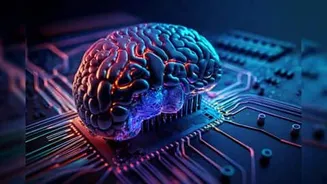
The technology aiming to restore sight is known as a visual prosthesis, or a 'bionic eye'. Instead of repairing the eyes, some of the most advanced systems bypass the eyes and optic nerve altogether. They use a camera, typically mounted on a pair of glasses, to capture the world. This visual data is then processed and converted into electrical signals, which are sent to a tiny array of electrodes surgically implanted directly onto the brain's visual cortex. Each electrode's pulse stimulates a small group of neurons, causing the person to perceive a dot of light called a 'phosphene'. The goal is to arrange these phosphenes into a coherent picture, much like pixels on a screen.
The Challenge of Creating a Clear Picture
The central problem is that creating a useful image is far more complex than simply lighting up a few phosphenes. Early attempts often result in a chaotic or blurry collection of light spots rather than a distinct shape. This is because the brain's visual cortex is an incredibly dense and complex structure. To create a recognizable image of, say, a doorway, the electrodes must stimulate the correct neurons with immense precision in both space and time. If the stimulation is too strong or affects too wide an area, the individual phosphenes merge into an indistinguishable blob. Researchers are finding that the pattern and timing of the electrical pulses are critical to forming a stable and clear perception.
What Makes an Image 'Useful'?
The aim of current research is not to restore perfect, high-definition vision. Instead, the focus is on creating 'functional' or 'useful' sight. This means providing enough visual information to dramatically improve a person's quality of life. A useful image might allow someone to distinguish between light and dark, identify the presence and location of an object, recognize the basic shape of a face, or navigate a room without assistance. Even a low-resolution image composed of a few hundred phosphenes could be transformative, offering a level of independence that was previously impossible for those with total blindness. The utility of a visual prosthesis lies in its ability to provide these cohesive, meaningful percepts.
The Road Ahead for Artificial Vision
Achieving the required precision is a monumental task. One of the biggest challenges is that the layout of phosphenes varies from person to person, meaning each implant must be carefully mapped and calibrated. Recent research focuses on developing more sophisticated electrode arrays and smarter stimulation algorithms. Some systems are now exploring how to 'read' the brain's response to stimulation in real-time and adapt the electrical pulses accordingly. Teams like the one at the Illinois Institute of Technology have successfully implanted wireless devices that are providing researchers with long-term data on how the brain learns to interpret these new signals. While still in early stages, these studies are crucial for refining the technology and making artificial vision a viable therapy.