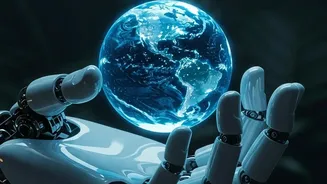








Your New Coding Partner
For years, writing software involved long hours spent on repetitive tasks: setting up boilerplate code, writing standard functions, and hunting for syntax errors. Today, a significant portion of that work is being handed off to artificial intelligence.
Tools like Anthropic's Claude and OpenAI's Codex, which powers GitHub Copilot, function as sophisticated pair programmers. Trained on vast libraries of public code, these large language models can generate code from natural language prompts, suggest completions for lines in progress, and even help debug existing work. Surveys show a massive uptake, with some reports indicating that a majority of developers have already integrated these AI tools into their workflows. The reason is simple: they promise to make development faster and more efficient, and for many routine tasks, they deliver.
Automating the Annoyances
The most immediate impact developers report is the automation of drudgery. Instead of manually writing every single line, developers can now describe a function's purpose and have an AI generate a solid first draft. This significantly reduces the time spent on what many consider the least creative parts of the job. Reports suggest developers can save several hours a week, time that is then reallocated to more complex and valuable activities. This shift allows engineers to focus less on the 'how' of writing code and more on the 'what' and 'why'—designing systems, solving architectural puzzles, and collaborating with team members on feature development. Essentially, the AI handles the grunt work, freeing up human developers to focus on higher-level problem-solving.
A Shift from Creator to Supervisor
However, this new partnership is fundamentally changing the nature of a developer's job. The role is evolving from one of pure creation to one of direction, evaluation, and verification. AI-generated code is not perfect; it can contain subtle bugs, security vulnerabilities, or simply be inefficient. As a result, developers now spend more time reviewing and validating code than ever before. This has created what some researchers call "supervisory engineering work." The crucial skill is no longer just the ability to write code, but the ability to critically assess AI-generated output, understand its implications, and correct its mistakes. Human oversight is critical, as an AI assistant lacks the deep business context or understanding of a complex system's hidden dependencies.
New Challenges and a Widening Skills Gap
While productivity metrics often look good, the new workflow introduces its own set of challenges. Some studies have noted a "productivity-experience paradox": while developers feel more productive, they also report increased cognitive load and a diminished sense of flow. The constant need to supervise the AI can be mentally taxing. Furthermore, there are growing concerns about the impact on junior developers. With AI absorbing many of the entry-level tasks that once served as a training ground, the traditional path to seniority is becoming less clear. Companies are now grappling with how to train the next generation of senior architects and lead engineers when the foundational experiences are being automated away. The skills required are shifting towards prompt engineering, system design, and deep domain knowledge, which compounds over a career.