

A Cosmic Wobble
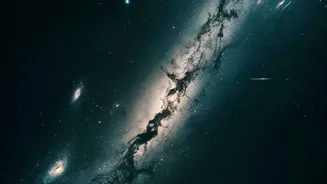
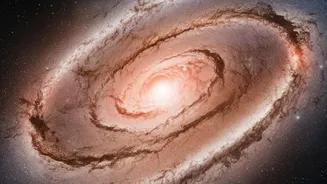
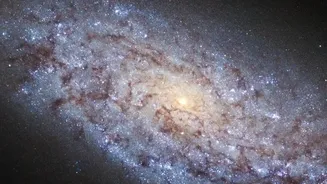
Our galaxy isn't a perfectly flat, spinning disc. For decades, astronomers have known that the Milky Way's disc is warped, curving upwards on one side and downwards on the other. More recent discoveries, thanks to the European Space Agency's (ESA) Gaia
space telescope, have shown this warp isn't static; it wobbles and precesses like a spinning top. Imagine throwing a rock into a pond—the ripples that spread out are a good analogy for disturbances that can affect a galactic disc. But the sheer scale of our galaxy's distortion suggested a far more powerful and ancient cause.
The Prime Suspect: A Galactic Collision
New research suggests this tilt is the lasting scar of a monumental, head-on collision that occurred around 10 billion years ago. The culprit was a smaller, dwarf galaxy that astronomers have nicknamed Gaia-Sausage-Enceladus. This name comes from the sausage-like shape of the orbits its scattered stars now follow within our galaxy. Though classified as a dwarf galaxy, it was immense, containing more than 10 billion times the mass of our sun in stars, gas, and dark matter. This event is now considered the last major merger in the Milky Way's history, fundamentally reshaping our galactic home.
Flipping The Entire Galaxy
The impact from the Gaia-Sausage galaxy was so cataclysmic that it didn't just ripple the disc—it likely flipped the entire Milky Way. Using powerful supercomputer simulations, astronomers at Durham University demonstrated that a head-on collision of this magnitude could exert enough gravitational force to slowly reorient the entire galactic disc by more than 90 degrees over hundreds of millions of years. This dramatic "disc flip" provides a compelling explanation for a long-standing astronomical mystery: the surprisingly slow rotation of our galaxy's stellar halo.
Cosmic Detective Work
The evidence for this ancient crash comes from meticulous cosmic detective work. The ESA's Gaia mission has been building an unprecedented 3D map of our galaxy, tracking the positions, speeds, and trajectories of billions of stars. These observations revealed that stars in the sparse, spherical region surrounding the disc, known as the stellar halo, rotate far more slowly than stars within the disc itself. The simulations showed that a massive, head-on merger followed by a disc flip was one of the only scenarios that could produce such a slow-moving halo. The debris from the Gaia-Sausage galaxy, now mixed into our own, holds the memory of this violent, transformative event.