





Not Fire, Not a Rainbow
The captivating phenomenon often called a 'fire rainbow' has a much more scientific, albeit less catchy, name: a circumhorizontal arc. This optical illusion is not related to fire in any way, nor is it a true rainbow. While rainbows are formed by the
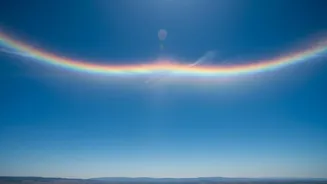
refraction and reflection of light in liquid water droplets, a circumhorizontal arc is created by light passing through ice crystals. The 'fire' part of the name likely comes from its vibrant, flame-like colours and the fact that it often appears in wispy cirrus clouds, which can look like flames in the sky. Unlike a classic arched rainbow that appears opposite the sun, this arc is a broad, colourful band that runs parallel to the horizon, far below the sun.
The Perfect Recipe for a Sky Painting
Creating a circumhorizontal arc requires a very specific set of ingredients, which is why they are a relatively rare sight. First, you need high-altitude cirrus or cirrostratus clouds, which are found above 20,000 feet where temperatures are low enough for ice crystals to form. But not just any ice crystals will do. They must be tiny, plate-shaped hexagonal crystals that are aligned horizontally, almost like millions of tiny prisms floating parallel to the ground. The final crucial ingredient is the sun's position. For the light to pass through the vertical side of the ice crystal and exit through the bottom face, the sun must be very high in the sky—at an elevation of at least 58 degrees above the horizon.
How Ice Crystals Split the Light
When sunlight strikes these perfectly aligned, plate-like ice crystals at such a high angle, it enters a vertical side face and exits through the horizontal bottom face. This 90-degree bend acts like a prism, separating the white sunlight into its various colour components. This process is known as refraction. Red light is bent the least, so it appears at the top of the arc, while violet light is bent the most and appears at the bottom. Because all the countless ice crystals in the cloud are oriented in the same way, they all refract the light in unison, creating a single, vast, and brilliantly coloured band across the sky. The colours are often purer and more vibrant than those in a typical rainbow.
A Rare Sight in Certain Places
The strict requirement for the sun to be at least 58 degrees high means that circumhorizontal arcs can't be seen everywhere on Earth. In locations at latitudes above 55 degrees, the sun never gets high enough in the sky for this phenomenon to occur. This makes it an impossible sight in much of northern Europe, for example. In mid-latitude regions, however, the chances are much better, especially during the summer months when the sun reaches its highest point in the sky. For instance, Los Angeles can see the necessary solar elevation for 670 hours between late March and late September, whereas London only experiences it for about 140 hours in its summer months. Even when the conditions are right, the arc will only be visible if the right type of cirrus clouds are present.
NASA's Eye on Atmospheric Optics
NASA's Astronomy Picture of the Day (APOD) recently featured a stunning example of a circumhorizontal arc over West Virginia, highlighting how ice crystals in a distant cirrus cloud acted as 'little floating prisms'. Such images are more than just beautiful snapshots of our sky. They serve as perfect educational tools to explain complex atmospheric optics. By studying phenomena like circumhorizontal arcs, scientists can gain a better understanding of cloud composition, atmospheric particle shapes, and how light behaves in our atmosphere. While often confused with other phenomena like cloud iridescence—which is caused by diffraction rather than refraction and can appear in different types of clouds—the specific geometry of a circumhorizontal arc makes it a clear indicator of these very specific atmospheric conditions.