



A Growing and Crowded Solar System
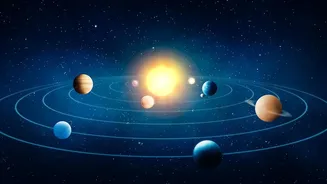
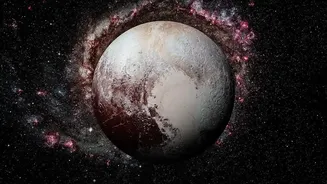
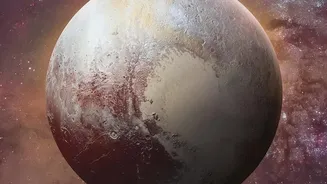
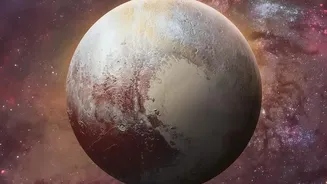
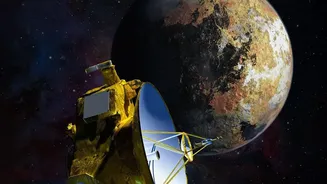
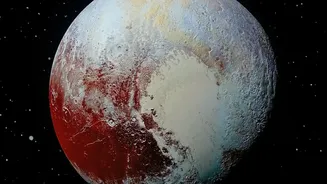
For over 75 years after its discovery in 1930, Pluto was comfortably known as the ninth planet. It was the small, icy world at the edge of our solar system. But as technology improved, astronomers began finding other objects in the same distant region,
known as the Kuiper Belt. The turning point came in 2005 with the discovery of Eris. Initial observations suggested Eris was even larger than Pluto. This created a problem for astronomers. If Pluto was a planet, then Eris should be one too. And what about the other large, icy bodies being found? The solar system was suddenly looking a lot more crowded, and the term 'planet' was becoming confusing. Instead of adding a dozen or more new planets, the scientific community realised they needed a clearer definition.
The Three Rules of Planethood
In August 2006, the International Astronomical Union (IAU), the organisation responsible for naming celestial objects, met to solve this problem. After much debate, they established three official criteria that a celestial body must meet to be classified as a planet in our solar system. The rules are: 1. It must be in orbit around the Sun. 2. It must have sufficient mass for its self-gravity to pull it into a nearly round shape (a state known as hydrostatic equilibrium). 3. It must have 'cleared the neighbourhood' around its orbit. Pluto checks the first two boxes easily. It orbits the Sun, and it is large enough to be spherical. The issue lies entirely with the third, and most controversial, rule.
The Sticking Point: Clearing the Neighbourhood
So, what does it mean for a planet to 'clear its neighbourhood'? Essentially, it means the planet must be the dominant gravitational force in its own orbit. Over billions of years, a true planet's gravity will either absorb smaller objects in its path, fling them into a different orbit, or capture them as moons. Think of Earth or Jupiter; while asteroids might cross their paths, they are the undisputed kings of their orbital zones. Earth, for example, is 1.7 million times more massive than all other objects in its orbit combined. Pluto, however, is in a very different situation. It orbits within the crowded Kuiper Belt, a region teeming with other icy bodies. Pluto is not the gravitational heavyweight in its zone; in fact, it is only a fraction of the total mass of the other objects in its orbit. Because it shares its orbital path with so many other significant objects, it fails to meet the third criterion.
Not a Demotion, But a New Classification
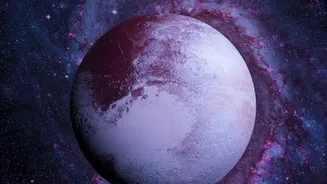
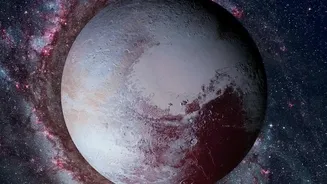
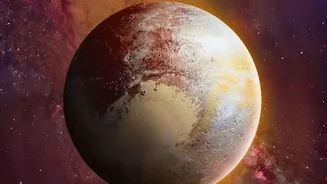
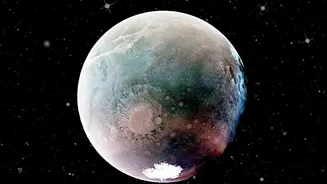
The term 'dwarf planet' was created to describe objects like Pluto. A dwarf planet is a celestial body that orbits the Sun and is round, but has not cleared its orbital neighbourhood. Pluto wasn't demoted as much as it was reclassified as the first member of this new, important category. It joined other fascinating worlds like Eris, which sparked the debate, as well as Ceres (which was once considered just an asteroid), Haumea, and Makemake. This new classification doesn't make Pluto any less interesting. If anything, it highlights the incredible diversity of objects in our solar system. These dwarf planets are pristine relics from the formation of our solar system, offering invaluable clues about our cosmic origins.