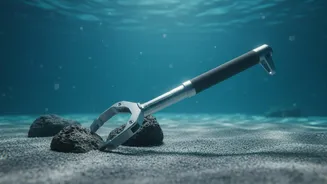








An Ocean Floor Moonscape
In a recent test at NASA's Neutral Buoyancy Laboratory (NBL) in Houston, two exploration geologists suited up and descended into the massive, 40-foot-deep pool. This wasn't for a swim; it was the first time two geologists were simultaneously suited for a simulated
moonwalk to practice the complex art of lunar geology. The NBL, a pool large enough to hold a replica of the International Space Station, had a section of its floor transformed into a lunar landscape, complete with simulated soil and rocks. There, scientists Trevor Graff and Angela Garcia tested prototype spacesuits and geology tools, working to refine the procedures future moonwalkers will use. It’s all part of preparing for the Artemis missions, which aim to land the first humans on the Moon since the Apollo era ended in 1972.
Why Practice Underwater?
The Moon's gravity is just one-sixth that of Earth's, a condition that is impossible to replicate perfectly on our planet. However, neutral buoyancy—achieved by weighting astronauts and equipment underwater until they neither sink nor float—provides a valuable simulation. While it's primarily used to train astronauts for weightless spacewalks outside the International Space Station, the technique can be adapted for partial gravity. By carefully adjusting the weights, trainers can approximate the feeling of moving and working in the Moon's low-gravity environment. This allows astronauts and scientists to get a feel for how to handle tools, move in a bulky spacesuit, collect samples, and even how to get up after a fall. These underwater missions, along with desert-based simulations in places like Arizona's volcanic fields, are known as analog environments, providing crucial data for mission planning.
Training for the Lunar South Pole
The recent underwater tests had a very specific focus: preparing for the challenges of the lunar South Pole. This region is a top priority for NASA's Artemis program because its permanently shadowed craters are believed to contain water ice, a vital resource for future long-term missions. However, these shadows also create extreme lighting conditions. To simulate this, the NBL test was conducted with low-angle lighting, mimicking the harsh, long shadows that astronauts will encounter. The geologists practiced deploying a mock lunar payload and using scientific instruments in this difficult environment, ensuring the procedures are effective even with minimal light. This kind of hands-on testing helps refine everything from the design of a chisel to the best way to communicate with the science team back in Houston.
A Critical Step for Artemis
While the Artemis II mission recently flew around the Moon, subsequent missions like Artemis IV are planned to land astronauts on the surface. The work being done underwater is a direct feed into those future landings. Axiom Space, which is developing NASA's next-generation lunar spacesuits, noted the joint training was a key milestone. Every task practiced, from swinging a hammer to picking up regolith samples, helps mission planners create realistic timelines and training manuals for the astronauts who will one day perform these tasks for real. The tests inform how many spacewalks a mission might include and how far from the lander the crew can safely travel. Although no crew has been officially announced for the first landing mission, this preparatory work ensures that whoever is chosen will have the best possible training and equipment.