
A Galactic Twin, But Not Identical
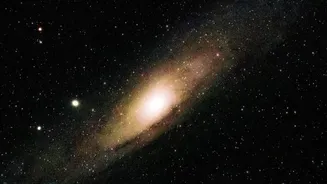
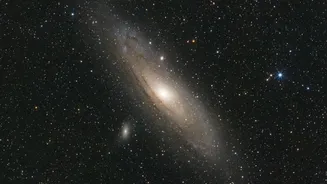
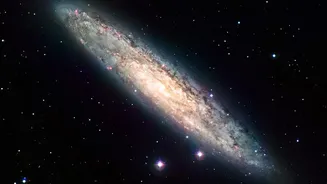
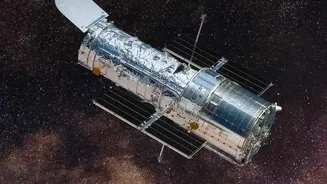
At 2.5 million light-years away, the Andromeda galaxy (M31) is the closest major spiral galaxy to our own Milky Way. This proximity is crucial for astronomers. It’s close enough for the Hubble Space Telescope to resolve hundreds of millions of individual
stars, yet far enough away to capture a big-picture view of the entire galaxy. This is a perspective we can never get of the Milky Way, because we are embedded deep inside it—like trying to understand a city’s layout while standing in the middle of a single park. By studying Andromeda, we get a proxy for understanding the evolution of large spiral galaxies, including our own. For years, scientists have used Andromeda as a model, but recent studies show its history might be quite different from ours.
A Cosmic Fossil Record
To unlock Andromeda's history, astronomers undertook a massive project called the Panchromatic Hubble Andromeda Treasury (PHAT) and its southern counterpart, PHAST. These surveys used Hubble to image large portions of the galaxy in multiple wavelengths, from ultraviolet to near-infrared. The different colours of light reveal stars of different ages. Massive, young stars burn hot and appear blue, but they have short lifespans. Less massive, older stars are cooler, appear redder, and live much longer. By counting the types of stars in different regions, scientists can create a 'fossil record' of star formation, mapping out when and where the galaxy was most active over billions of years. The combined surveys created a stunning mosaic from hundreds of Hubble snapshots, resolving over 200 million individual stars.
A Story of Decline
The most striking finding from this cosmic census is that Andromeda is a galaxy in decline. While scientists knew it had a massive burst of star formation about two billion years ago, likely from a merger with another galaxy, new research published in July 2026 shows what happened next. Over the last 500 million years, its rate of creating new stars has been steadily slowing down. The rate of star birth 500 million years ago was about one solar mass (the mass of our sun) per year, similar to the Milky Way's current rate. However, that has since plummeted to just one-fifth of a solar mass per year, with a particularly sharp drop in the last 40 million years. This suggests Andromeda is not running out of fuel but is naturally winding down after a more turbulent past.
Clues in a Ring of Fire
This slowdown isn't happening uniformly across the galaxy. Researchers discovered that much of the recent decline in star creation is driven by fading activity in a prominent ring of gas and dust located about 32,000 light-years from the galactic center. This ring was once a hotbed of stellar nurseries, but its output has significantly diminished. Furthermore, the data points to a potential culprit for some of this change: Andromeda's small satellite galaxy, M32. The region of Andromeda closest to M32 showed a more pronounced drop in star formation beginning around 60 million years ago, hinting that a past interaction with the smaller galaxy may have disturbed the gas and dust needed to form new stars.
A Mirror to Our Own Galaxy
Understanding Andromeda's life cycle provides critical context for our own Milky Way. While Andromeda appears to be entering a quieter phase, our galaxy is still relatively active. The detailed history of Andromeda’s merger events and subsequent star-forming booms and busts helps refine models of galaxy evolution. It shows that a galaxy's story is shaped by dramatic events like mergers, which can trigger massive bursts of star birth, followed by long periods of quiet decline. As Andromeda and the Milky Way are on a collision course set to occur in about 4 billion years, studying Andromeda's past gives us a preview of the dynamic and transformative future that awaits our own galactic home.