



A Mysterious Glow Appears
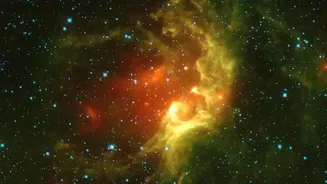
A team of researchers from the Chinese Academy of Sciences and the University of Notre Dame in the US has identified a fascinating new object within the Milky Way. They detected a bright cloud of high-energy light that appears to be a very young remnant
of a cosmic explosion. According to a paper they posted, which is currently awaiting peer review, this glow is small and bright—two key signs that point to a recent origin. While further study is needed, the initial evidence suggests astronomers may have found the fresh wreckage of one of the universe's most violent and productive events.
The Cosmic 'Gold Factory'
Scientists believe this bright remnant is the result of two neutron stars colliding. Neutron stars are the incredibly dense collapsed cores of massive stars that have gone supernova. A teaspoon of neutron star material would weigh a staggering billion tonnes. When two of these objects, locked in a decaying orbit, finally smash into each other, the resulting explosion is called a kilonova. This violent merger is theorized to be the universe's primary 'gold factory', spewing out a flood of neutrons that are rapidly absorbed by other atoms to forge the heaviest elements, like gold, platinum, and uranium. The research suggests that after this particular cosmic forge did its work, the remaining wreckage collapsed into a black hole.
Reading the Cosmic Clock
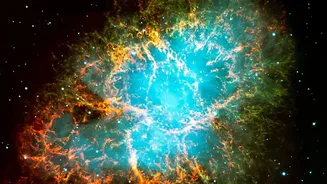
One of the most thrilling aspects of this discovery is the object's estimated age: possibly less than 1,000 years old. In cosmic terms, that is the blink of an eye. For comparison, the famous Crab Nebula is the result of a supernova seen on Earth in the year 1054. This new remnant could be even younger. Astronomers deduce its youth from its properties; the cloud of debris is still relatively small and shines brightly, indicating that the energy from the cataclysmic event has not had much time to dissipate into the vastness of space. Studying such a young remnant gives scientists an unparalleled opportunity to see the physics of a kilonova's immediate aftermath before the evidence fades.
A Celestial Event That Went Unseen
If such a dramatic explosion happened so recently, a natural question arises: why didn't anyone see it? The researchers suggest the initial event could have been as bright as Jupiter in our night sky. However, two factors likely contributed to it going unrecorded by historical astronomers. First, the initial flash of light from a kilonova is powerful but very brief, possibly fading from naked-eye visibility within a matter of days. Second, and more critically, the object's location in the sky was far to the south. This would have made it difficult, if not impossible, to observe for the most meticulous ancient record-keepers, including Chinese and European astronomers who were largely based in the Northern Hemisphere.
Why This Finding Is Important
Discovering a potential kilonova remnant this young and this close is a significant milestone. While astronomers have detected gravitational waves from distant neutron star collisions, finding the glowing remains of one inside our own galaxy offers a chance to study the process in much greater detail. It allows scientists to test their theories about how heavy elements are created and distributed throughout the cosmos. As researchers continue to analyze this mysterious glow, it could provide a direct look into the violent, creative forces that shape the universe and seed planets with the precious metals we find on Earth today. It serves as a powerful reminder that the sky above is not static, but a dynamic place of constant, explosive change.