


A New Eye on the Cosmos
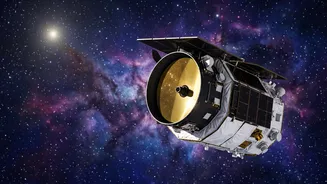
The Nancy Grace Roman Space Telescope represents a new era in astrophysics for NASA. Named after Dr. Nancy Grace Roman, the agency's first chief of astronomy and a tireless advocate for space-based telescopes, this observatory is designed to tackle some
of the biggest mysteries in the universe. Having successfully launched in late August 2026, it is currently en route to its observation point about 1.5 million kilometers from Earth, a stable location known as the second Lagrange point, or L2. The project has been a top priority for astronomers for over a decade, and its development has seen it stay on schedule and on budget, a significant achievement for an undertaking of this complexity.
The Heart of the Telescope
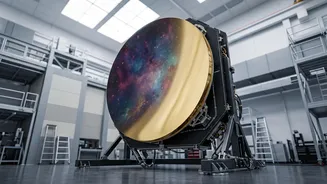
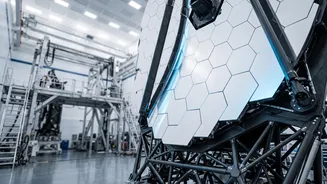
At the core of the Roman Telescope is its impressive 2.4-meter (7.9-foot) primary mirror. This is the same size as the mirror on the Hubble Space Telescope, but with a surprising origin story: it was originally built for a spy satellite and was donated to NASA by the National Reconnaissance Office. This repurposed hardware not only reduced the mission's cost and schedule but provided a world-class foundation for the observatory. The headline's phrase "brings the telescope's mirror into focus" figuratively represents the culmination of years of preparation. Engineers recently completed final inspections of the mirror, confirming it was in pristine condition and ready for its mission in space after passing crucial tests in extreme cold temperatures.
A Panoramic Universe
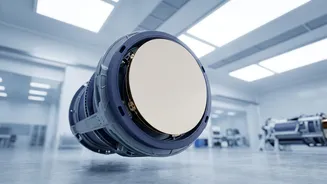
What truly sets Roman apart is its incredible field of view. While Hubble acts like a zoom lens, providing deep, detailed images of small patches of the sky, Roman is a panoramic mapping machine. Its Wide Field Instrument (WFI) can see an area of the sky 100 times larger than Hubble's cameras in a single shot, all while maintaining a similar sharpness and resolution in the near-infrared spectrum. This capability will allow Roman to survey vast cosmic landscapes with unprecedented speed. In its first five years, it is expected to image 50 times more sky than Hubble has in its entire 30-plus years of operation, creating the largest-ever panoramic surveys from space.
Unlocking Cosmic Mysteries
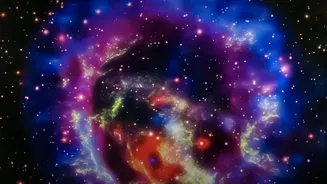
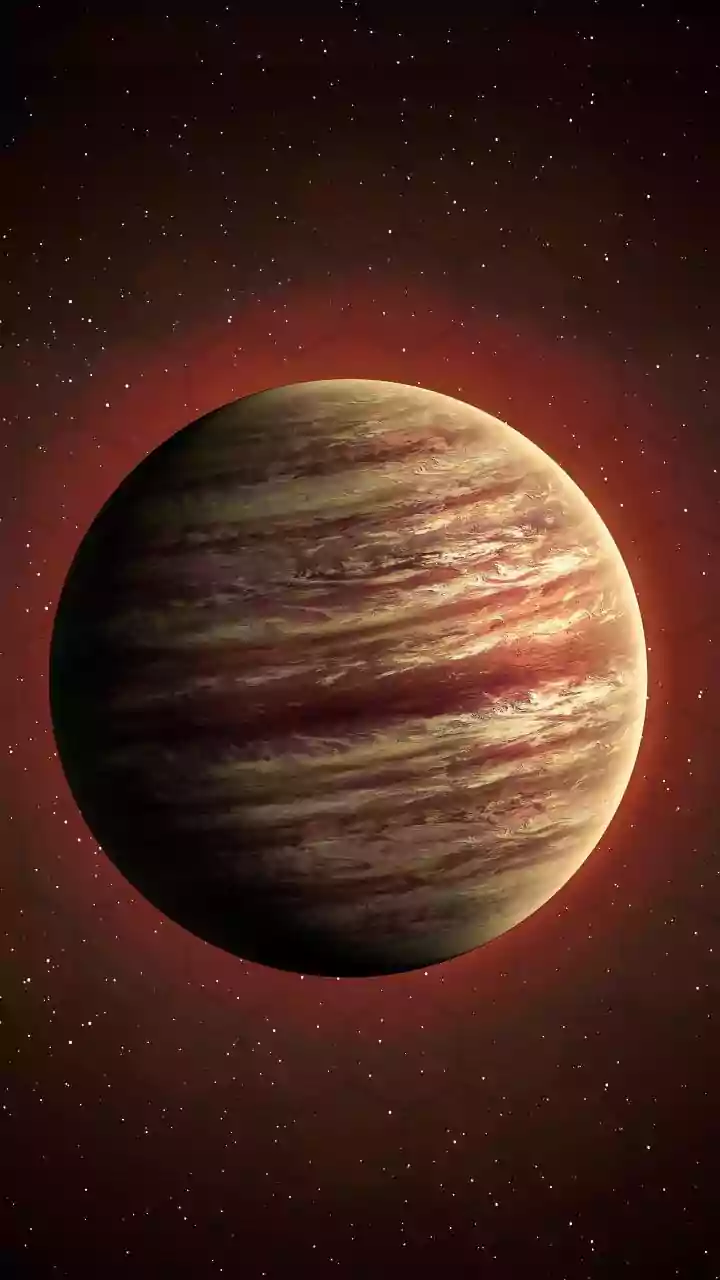
Roman has two primary scientific goals: to investigate the nature of dark energy and dark matter, and to conduct a massive census of exoplanets. Dark energy is the mysterious force thought to be causing the universe's expansion to accelerate, while dark matter is the invisible "glue" that holds galaxies together. By mapping the distribution and movement of over a billion galaxies, Roman will provide crucial data to test theories about these enigmatic cosmic components. At the same time, it will hunt for new planets outside our solar system using a technique called gravitational microlensing. It is expected to discover thousands of new worlds, from gas giants to rocky planets, vastly expanding our catalogue of known exoplanets.
Roman, Webb, and Hubble: A Collaborative Trio
Roman is not a replacement for the Hubble or James Webb space telescopes but a powerful complement to them. Think of them as a team of cosmic photographers. Roman is the wide-angle specialist, quickly identifying points of interest across huge areas. Webb, with its giant mirror optimized for infrared light, acts as the deep-space zoom, peering back toward the dawn of time. Hubble remains the master of high-resolution visible and ultraviolet light observations. Together, they form a multi-faceted toolkit for modern astronomy. Roman will find the cosmic "needles in a haystack," and Webb and Hubble can then be tasked to study those targets in greater detail.