




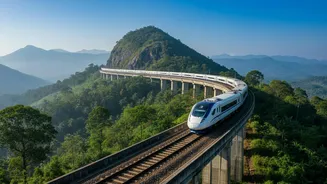
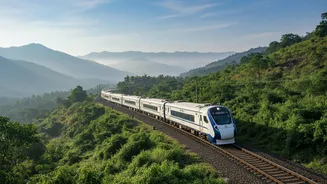
The Ambitious Bengaluru-Mangaluru Connection
The dream of a rapid, comfortable train journey from the tech hub of Bengaluru to the coastal city of Mangaluru is a step closer to reality, but it hinges on a critical 55-kilometre stretch of railway track. South Western Railway has commenced intensive
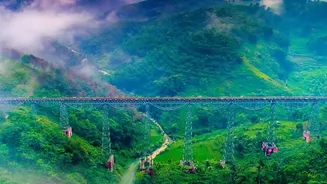
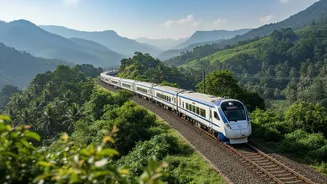
trials for a Vande Bharat service on the Sakleshpur-Subrahmanya Road ghat section. This route, celebrated for its stunning views through the Western Ghats, is equally infamous for its engineering challenges, which have historically limited train speeds and types. A successful Vande Bharat service would be a game-changer, potentially slashing travel time and providing a massive boost to tourism and business connectivity between Karnataka's capital and its coastal belt.
A Route of Stunning Beauty and Steep Challenges
To understand the complexity, one must look at the numbers. The Sakleshpur-Subrahmanya section features a steep gradient of 1 in 50, meaning the track rises one metre for every 50 metres forward. It winds through 57 tunnels, crosses 226 bridges, and navigates 108 sharp curves, all within a compact 55-kilometre corridor. These conditions have traditionally required the use of 'banker' locomotives—extra engines that push trains up the steep inclines to provide additional power. Furthermore, the route is highly susceptible to landslides during the monsoon, which can disrupt services for days. Due to these factors, the Commissioner of Railway Safety has capped the maximum permissible speed on this stretch at a cautious 30 km/h, a stark contrast to the Vande Bharat's typical operating speeds.
The Vande Bharat's Design Under Scrutiny
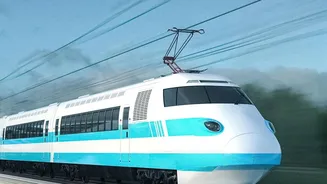
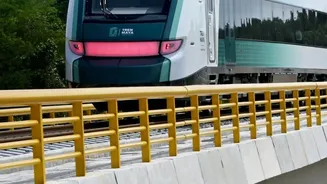
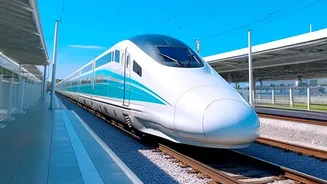
The Vande Bharat is not a conventional locomotive-hauled train. It operates on a distributed power system, where multiple coaches have their own motors. This design is excellent for rapid acceleration on flat terrain but presents a unique question on steep gradients. The trials, overseen by the Research Designs and Standards Organisation (RDSO), are designed to assess every aspect of the train's performance in this environment. Engineers are closely monitoring acceleration on inclines, braking effectiveness on descents, and overall stability while navigating sharp curves. A specially manufactured 20-car rake equipped with an Automatic Emergency Braking (AEB) system is being used for these tests. This AEB system is a crucial safety feature, designed to automatically apply the brakes if the train exceeds speed limits on the treacherous slopes.
The Road to Approval
The path to launching the service is methodical. The current field trials, which began around August 11, 2026, are a critical data-gathering phase. These follow the successful electrification of the entire Bengaluru-Mangaluru line, a major project in itself that was completed to enable the operation of modern electric trains like the Vande Bharat. Railway officials have stated that successful completion of these trials and obtaining the necessary safety clearances from the RDSO are mandatory before a regular service can be considered. While there is immense public anticipation and political will, with ministers having previously announced intentions to launch the service, safety and technical feasibility remain the paramount concerns.