







More Than Just a Conference
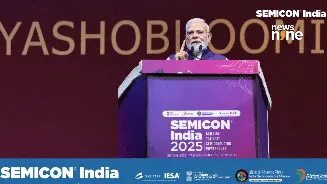
On September 17, Prime Minister Narendra Modi will officially open the fifth edition of SEMICON India, set to take place from September 17-19 at Yashobhoomi in New Delhi. This isn't just another industry meet-up; the PM's presence signals a strong government
commitment to a sector deemed critical for national security and economic progress. The event, themed “Silicon to Systems: Building the Ecosystem,” is jointly organized by the India Semiconductor Mission (ISM) and the global industry association SEMI. It aims to bring together policymakers, investors, and top executives from over 40 countries to accelerate India's journey up the semiconductor value chain. With over 500 exhibitors and 150 international speakers, SEMICON India 2026 is poised to be the largest edition yet, reflecting surging global confidence in India's semiconductor story.
The Global Chip Race
Semiconductors, the tiny electronic brains inside everything from smartphones and cars to data centers and military hardware, have become a focal point of global competition. The recent pandemic exposed the fragility of a supply chain heavily concentrated in a few East Asian countries. This has prompted major economies to invest billions in developing their own domestic manufacturing capabilities to ensure supply chain resilience and strategic autonomy. The global market itself is booming, with some forecasts projecting annual sales to approach one trillion dollars by 2026, largely driven by the explosive growth of Artificial Intelligence. For nations, having a domestic chip industry is no longer a luxury but a strategic necessity, akin to ensuring energy or food security. India is determined not to be left behind in this critical race.
India's Grand Plan: The Semiconductor Mission
At the heart of this ambition is the India Semiconductor Mission (ISM), a comprehensive government program designed to build a complete ecosystem for chip manufacturing. The government has rolled out significant financial incentives to attract the massive investment required for setting up fabrication plants (fabs). The initial phase of the program, known as Semicon 1.0, has already seen the approval of several key projects, with some facilities expected to begin commercial production soon. The government recently approved the next phase, Semicon 2.0, with a renewed focus on six pillars: chip design, equipment and materials, more fabrication plants, advanced packaging (ATMP/OSAT), research and development, and talent development. This strategy aims to position India as a global hub for electronics manufacturing and design, reducing its heavy reliance on imports.
Challenges on the Road Ahead
Despite the strong momentum, the path to becoming a semiconductor powerhouse is steep and fraught with challenges. Building a semiconductor fab is incredibly capital-intensive, requiring billions of dollars in investment and cutting-edge technology that is often closely guarded. India faces stiff competition from established players like Taiwan, South Korea, and the United States, all of whom are also doubling down on their own semiconductor industries. Furthermore, the industry requires a highly specialized workforce, and developing a deep talent pool is a long-term challenge. Creating the necessary infrastructure, which includes an uninterrupted supply of power and ultra-pure water, also presents a significant hurdle. Success will depend not just on attracting investment but on systematically building the entire supporting ecosystem, from raw materials to a skilled workforce.