







A Planetary Puzzle
Imagine trying to figure out the weather on a mountain top by looking at it from a hundred kilometers away. That’s similar to the challenge astronomers face when studying exoplanets—worlds orbiting other stars. One of their best techniques is to watch
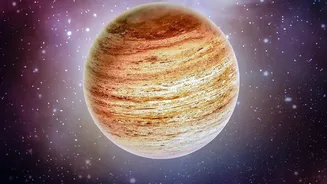
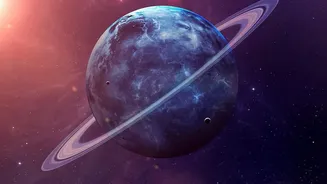
a planet pass in front of its star and analyze the starlight that filters through its atmosphere. Different gases block different colors of light, creating a chemical fingerprint. But for a certain class of planets, often called “super-puffs” or “mini-Neptunes,” the results were often confusing. These planets, larger than Earth but smaller than Jupiter, seemed to have atmospheres that were hard to read, sometimes appearing smaller or less distinct than theories predicted. It was a persistent puzzle: what were these planetary atmospheres really like, and why were they so elusive?
The Helium Breakthrough
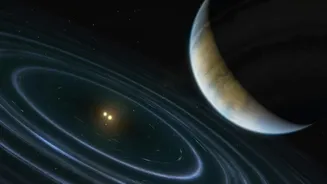
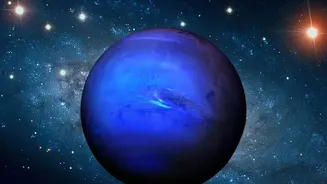
The first major clue came not from what was missing, but from what was unexpectedly there. In 2018, astronomers using the Hubble Space Telescope pointed it at WASP-107b, a puffy planet about 200 light-years away. Using a novel technique to look for signals in infrared light, they found something remarkable: a gigantic, extended cloud of helium surrounding the planet. Helium, the second most common element in the universe, had been surprisingly difficult to spot on exoplanets before this. The observation showed that the planet’s atmosphere wasn’t just a neat layer, but was actively being stripped away by the radiation from its star, bleeding a huge tail of helium into space. This process is called atmospheric escape, and suddenly seeing it in action was a game-changer.
A Tale of Two Telescopes
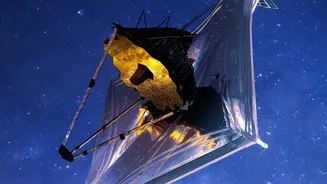
Hubble, the venerable workhorse of space astronomy, made the initial discovery possible. But to truly understand the phenomenon, it needed a partner with even sharper vision. Enter the James Webb Space Telescope (JWST). While Hubble could detect the presence of the escaping helium, Webb’s superior sensitivity can do much more. Webb can map the shape and structure of the escaping gas cloud with incredible precision. Recent observations have shown that the helium cloud around WASP-107b is so vast that it begins to block the starlight long before the solid planet does. Webb can also identify other, heavier elements that are being dragged along for the ride. This tag-team approach is what makes the two telescopes so powerful; Hubble identifies a new, promising target for investigation, and Webb performs the deep, detailed analysis.
Solving One Mystery...
The helium finding solved the old puzzle. The reason some planets' atmospheres seemed muted or hard to define was that a significant portion of them wasn't neatly contained but was actively gushing into space. The intense radiation from the host star effectively boils off the lightest elements, starting with hydrogen and then helium, creating a vast, diffuse halo that older methods struggled to interpret. This explained why some planets appeared to have odd sizes; their visible radius was being distorted by this massive, escaping envelope of gas. Instead of a static object, astronomers realized they were looking at a dynamic, evolving system.
...And Creating a Better Question
This is where the follow-up question becomes so much clearer. Before, astronomers were asking a basic question: “What is this planet’s atmosphere made of?” Now, thanks to the tandem work of Hubble and Webb, they can ask a far more sophisticated one: “How fast is this planet losing its atmosphere, what is it losing, and how does this process shape the planet’s ultimate fate?” Scientists are no longer just taking a planetary snapshot; they are watching its life story unfold. By measuring the rate of mass loss, they can rewind the clock to understand how the planet formed and fast-forward to predict whether it will eventually be stripped down to its rocky core or manage to retain a sliver of its atmosphere. This new line of inquiry is crucial for understanding the diversity of planets in the galaxy and, ultimately, which ones might be stable enough to support life.