



The Elusive Cosmic Breeze
For decades, scientists have theorized that as supermassive black holes devour matter, they must also expel powerful outflows of gas and energy. This phenomenon, known as a "black hole wind," is a crucial ingredient in models of galaxy evolution. However,
directly observing this wind, especially from the relatively quiet black hole at the center of our own Milky Way, Sagittarius A (Sgr A), has been notoriously difficult. Now, after analyzing five years of detailed observations, astrophysicists have finally seen its distinct signature. Using the Atacama Large Millimeter/submillimeter Array (ALMA) in Chile, a team from Northwestern University detected a cone-shaped cavity in the cold gas surrounding Sgr A, which they identified as the unmistakable imprint of this long-sought wind.
What Exactly Is a Black Hole Wind?
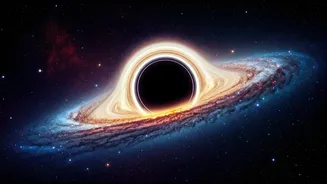
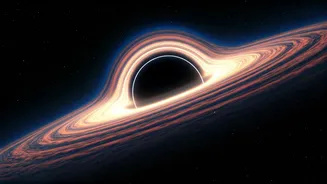
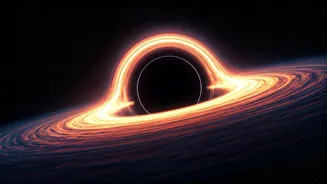
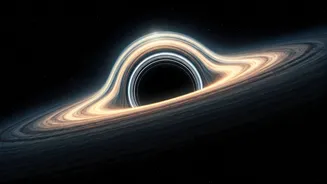
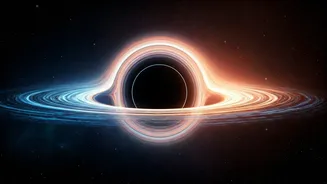
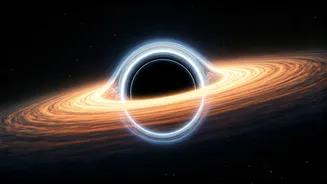
Contrary to the image of a black hole as a purely cosmic vacuum cleaner, they are incredibly messy eaters. As gas, dust, and stars are pulled toward a black hole, they form a swirling, intensely hot disk called an accretion disk. The friction and energy within this disk get so extreme that it blasts radiation outward, pushing away a significant portion of the infalling material as a stream of hot gas and charged particles. This outflow is the "wind." In galaxies with hyperactive black holes, called quasars, these winds can be ferocious, traveling at incredible speeds and carrying the mass of hundreds of suns each year. While the wind from our galaxy's more sedate black hole is gentler, its existence confirms that even quiet black holes are constantly interacting with their surroundings.
A Shadow in the Starlight
Seeing the wind itself is nearly impossible, so scientists looked for its effects. Think of it like seeing the path of wind through leaves or dust. The team used ALMA’s 66 radio antennas to get the sharpest image ever of the cold molecular gas within three light-years of Sgr A. They noticed a distinct, three-light-year-long void in this gas cloud. When they overlaid this data with observations from NASA's Chandra X-ray Observatory, which maps hot gas, the pieces clicked into place. The void seen by ALMA was filled with the hot gas detected by Chandra, indicating that a powerful outflow from the black hole had carved out a path, like a snowplow clearing a road. This "imprint" or shadow in the cold gas provided the first unambiguous evidence of the wind in action.
Why This Discovery Matters
The discovery is more than just solving a long-standing puzzle; it has profound implications for how we understand the universe. These winds act as a cosmic feedback mechanism. They can blow away the raw material needed for star formation, effectively "quenching" a galaxy and stopping it from creating new stars. Conversely, the pressure from these winds can sometimes compress gas clouds, triggering bursts of star birth. By observing this process up close in our own galaxy, astronomers can better understand how supermassive black holes regulate the growth and evolution of their host galaxies across cosmic time. It helps explain the observed correlation between the mass of a galaxy's central black hole and the properties of the galaxy itself—a link that gravity alone cannot account for.
What Happens Next?
This finding confirms that Sgr A* is not a unique exception and behaves like other supermassive black holes, just on a much quieter scale. It provides a local laboratory for studying a phenomenon seen in more distant, active galaxies. Astronomers will now work to measure the wind's properties more precisely, such as its speed, temperature, and how its direction might change over time. Instruments like the Very Large Telescope (VLT), which has also been used to study black hole outflows and star formation within them, will continue to play a crucial role. Understanding these gentle breezes from our own black hole could be the key to understanding the violent gales that shaped galaxies in the early universe, providing a new scenario for our understanding of galaxy evolution.