






A Decades-Old Antarctic Mystery
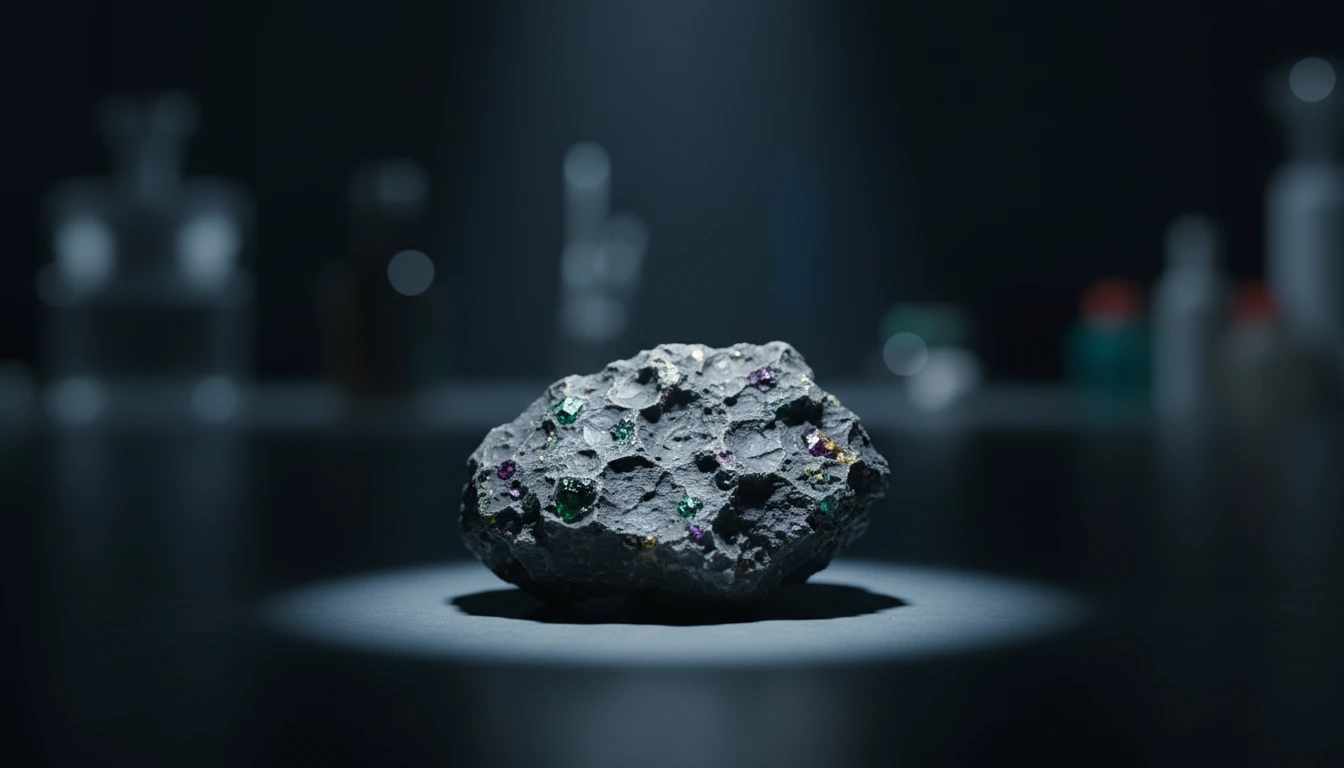
In 1982, a meteorite-hunting expedition in Antarctica's Allan Hills made a significant find: a small, 31-gram rock. Cataloged as Allan Hills A81005, or ALHA 81005, scientists quickly suspected it was special. By 1983, analysis confirmed its extraordinary
origin. Its chemical and isotopic makeup was a match for the lunar highlands, the Moon's ancient, cratered crust. It was the first meteorite ever to be conclusively identified as coming from the Moon. For over four decades, ALHA 81005 was a valuable piece of the Moon on Earth, but its exact point of origin on the lunar surface remained a tantalizing mystery. It was a postcard from the Moon with no return address.
India's Rover Finds the Missing Link
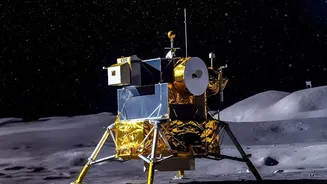
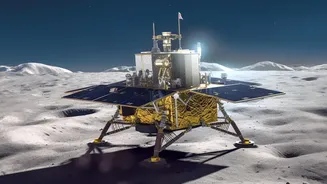
The key to solving the mystery came from India's successful Chandrayaan-3 mission. In 2023, its Pragyan rover landed near the lunar south pole, at a site named Shiv Shakti Statio. Onboard the rover was an instrument called the Alpha Particle X-ray Spectrometer (APXS), designed to analyze the chemical composition of the lunar soil. Recently, scientists at the Physical Research Laboratory (PRL) in Ahmedabad compared the APXS data from Shiv Shakti with the known geochemistry of 66 different lunar meteorites found on Earth. The results, published in mid-2026, were remarkable. Of all the samples, ALHA 81005 was the closest chemical match to the soil at the Chandrayaan-3 landing site.
The Shared Chemical Fingerprint
The connection wasn't just a vague similarity; it was a specific geochemical signature. The soil at the Shiv Shakti site and the meteorite both show a distinct composition: they are relatively poor in aluminum but have elevated levels of iron and magnesium compared to typical lunar highlands. Both also occupy a rare compositional space between two major groups of lunar rocks, further strengthening their link. This suggests that a powerful impact event on the Moon, likely near the south pole, ejected this piece of crust with enough force to send it on a journey to Earth, where it eventually landed in Antarctica.
Why This Matters for the New Space Race
This discovery is more than just a fascinating scientific footnote; it has major implications for the business of space exploration. The lunar south pole is the target destination for NASA's Artemis program and missions from other nations, largely because its permanently shadowed craters are believed to hold vast quantities of water ice. This ice could be mined for drinking water, breathable oxygen, and, crucially, hydrogen for rocket fuel. Having a confirmed physical sample from this exact region—without having to fly there and bring it back—is a massive advantage. ALHA 81005 provides "ground truth" that can help refine remote sensing data from orbiters and improve our maps of the area's resources.
Informing the Next Giant Leap
For companies and agencies planning future lunar missions, this meteorite is now a priceless guide. It offers tangible clues about the geology and material properties of the very ground where future astronauts might land and work. Understanding the composition of the soil is critical for designing rovers, habitats, and mining equipment. The connection also reinforces theories that the massive South Pole-Aitken basin, an ancient impact crater, has distributed material from the Moon's deep crust or even its upper mantle across the south polar region. Astronauts landing near these areas may have access to incredibly ancient materials that could rewrite our understanding of how the Moon—and by extension, the Earth—was formed, all thanks to a chemical clue found in an Antarctic rock.