








The Founder's Final Dream
Before the iconic F1 defined a generation of supercars, Bruce McLaren had another vision: a road-legal monster born from his dominant Can-Am race cars. In the late 1960s, McLaren's M6A racers were nearly unbeatable, earning the championship the nickname
'the Bruce and Denny show' for him and fellow Kiwi driver Denny Hulme. Bruce dreamed of leveraging this track supremacy to build the world's fastest and best-handling road car. The plan was to create a coupe version of the M6, called the M6GT, to compete in endurance racing and sell to the public. He personally drove a prototype as his daily car, a testament to his belief in the project.
A Vision Unfulfilled
Tragically, the M6GT project was halted by Bruce McLaren’s untimely death in 1970 while testing a new race car at the Goodwood circuit. At the time, only a handful of M6GT prototypes had been completed, and without the founder's driving force, the ambitious plan to build 250 production cars was shelved. The M6GT became one of motorsport’s great “what ifs,” a tantalizing glimpse into a future that never was. The ideas behind it, however, didn't disappear entirely; they would re-emerge more than two decades later in the legendary McLaren F1.
Resurrection by MSO
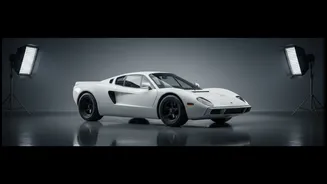
Now, more than 50 years later, McLaren's in-house bespoke division, MSO, has brought the founder's vision to life. This is not a modern reinterpretation but a faithful recreation billed as a 'restoration'. The project started with the chassis of a period-built M6A race car. The team then unearthed the original M6GT body molds in the UK, which were used to form the car's sleek, low-slung bodywork. The molds even showed evidence of design modifications made back in the 1960s, which MSO preserved to maintain the car's historical authenticity.
Authenticity in Every Detail
MSO's focus was on creating a car that was as true to the original concept as possible. The vehicle is powered by a period-correct, Chevrolet small-block V8 engine, just as the original would have been. Specialists painstakingly restored original M6GT suspension hardware, even sourcing rare imperial-era bearings. Many structural elements, like the roll hoop and internal reinforcements, were hand-fabricated based on archival drawings. Inside, the commitment to heritage continues with green vinyl seats and a gear knob carved from hand-turned walnut. The car is finished in a bespoke shade called Colnbrook White, named for the area where Bruce McLaren first developed his road car ideas.
More Than Just a Car
This one-off M6GT, which is set to debut at the Goodwood Festival of Speed, is more than just a car; it's a piece of rolling history. It serves as the launch of a new Heritage Collection within MSO, a division dedicated to preserving McLaren's most important historic vehicles. For a brand built on cutting-edge technology, this project is a powerful statement about the value of its own origin story. It’s a tribute to the founder's ambition and a tangible link between the company's racing past and its supercar present, finally completing a chapter that was left open for half a century.