
What Are We Actually Seeing?
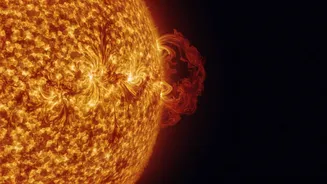
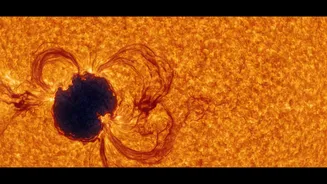
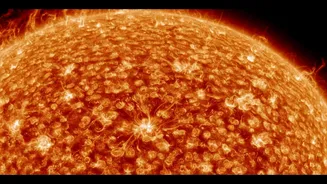
The incredible new images showcase a phenomenon on the sun that scientists had long theorized about but never directly observed on its surface. These mesmerizing swirls are the result of what is known as the Kelvin-Helmholtz instability (KHI). This effect
occurs when two streams of fluid or plasma, moving at different speeds, slide past each other. The friction at their boundary creates a shear force, causing the interface to curl into a vortex, much like wind creating waves on water or the iconic patterns in Jupiter's atmosphere. On the sun, these swirling motions are happening in superheated plasma at the edges of 'granules' — massive, Texas-sized cells of convecting gas that constantly bubble up from the sun's interior, cool, and sink back down. The swirls themselves, while smaller, are still immense, with some features measuring only about 20 kilometers across, a scale so small on the sun it's like spotting a coin from 180 kilometers away.
A Telescope of Unprecedented Power
These groundbreaking observations were made possible by the National Science Foundation's Daniel K. Inouye Solar Telescope. Perched atop the Haleakalā volcano in Maui, Hawaii, it is the largest and most powerful solar observatory in the world. Its massive 4-meter (13-foot) primary mirror collects more sunlight than any other solar telescope, allowing it to resolve features on the sun's surface with astonishing clarity. The location in Hawaii provides exceptionally clear skies, and the telescope is equipped with advanced adaptive optics that correct for the blurring effects of Earth's atmosphere in real-time. This combination of size, location, and technology allows astronomers to see details that were previously impossible to capture, pushing the boundaries of solar science.
More Than Just a Pretty Picture
Observing these plasma swirls is far more significant than just capturing a beautiful image. Scientists believe this instability could be a key piece in solving some of the sun's most enduring mysteries. One major puzzle is the 'coronal heating problem': the sun's outer atmosphere, the corona, is millions of degrees hotter than its surface, which is a comparatively cool 5,500 degrees Celsius. This defies the simple logic that it should be cooler farther from the heat source. These tiny Kelvin-Helmholtz vortices may act like tiny engines, transferring and cascading energy from the surface up into the corona, helping to superheat it. By studying how this energy moves on a small scale, scientists hope to finally understand the mechanics of this massive atmospheric anomaly.
From Solar Secrets to Earthly Impacts
Understanding the sun's complex behavior is not just an academic exercise; it has direct implications for life on Earth. The same magnetic forces at play in these tiny swirls are connected to much larger and more violent solar events, like solar flares and coronal mass ejections (CMEs). These powerful eruptions can send torrents of charged particles hurtling toward Earth, creating what is known as space weather. Severe space weather events have the potential to disrupt our modern, technology-dependent world by damaging satellites, interfering with GPS and communication systems, and even knocking out power grids. By observing how magnetic fields twist and build up energy at this fundamental level, researchers hope to improve their models and ability to predict these powerful solar storms, giving us more time to prepare and protect our critical infrastructure.