





The Case Against the Sit-Up
For decades, sit-ups were the undisputed king of abdominal exercises. The logic seemed simple: to strengthen your abs, you curl your torso up and down. However, modern fitness science and medical experts have raised significant concerns. The primary issue
lies with the movement itself: repetitive spinal flexion. When you perform a sit-up, you repeatedly push the natural curve of your lower back against the floor and then lift your upper body. This motion can place significant stress and compressive force on the discs in your lumbar spine. Over time, this can lead to discomfort, lower back pain, and even increase the risk of injuries like a herniated disc. Furthermore, sit-ups primarily work the hip flexor muscles, which run from the thighs to the lower spine. When these muscles become too tight from overuse, they can pull on the lower spine, contributing to bad posture and back pain.
The Plank: A Lesson in Stability
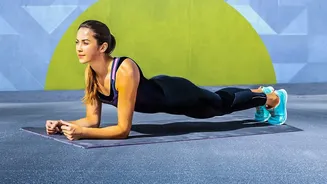
Enter the plank, an exercise that looks deceptively simple but has been hailed by experts as the new gold standard for core training. Unlike the sit-up, which focuses on movement (flexion), the plank is an isometric exercise. This means you hold a single position, forcing your muscles to work to maintain stability without movement. The main function of your core muscles isn't just to bend and twist, but more importantly, to resist motion and protect your spine. The plank trains your core exactly for this purpose. It teaches you to brace your entire midsection, creating a solid, stable link between your upper and lower body. This skill is far more functional for daily life—think of lifting a heavy box, standing for long periods, or maintaining balance. By promoting core stability rather than repeated bending, planks help protect the spine and can even alleviate existing back pain by strengthening the supporting muscles.
Engaging the Entire Core System
Another reason for the plank's superiority is the sheer number of muscles it engages. A sit-up isolates a relatively small group of muscles, primarily the rectus abdominis (the 'six-pack' muscles) and the hip flexors. A plank, on the other hand, is a full-body affair. It activates the entire core system three-dimensionally. This includes the deep transverse abdominis (which acts like a natural corset for your midsection), the obliques along your sides, the muscles of the lower back, and even your glutes, shoulders, and hamstrings. This balanced muscle recruitment is crucial for developing true functional strength. Everyday activities and sports don't ask your muscles to work in isolation; they require them to work together as a coordinated system. The plank trains your body in this integrated way, leading to better posture, improved balance, and a reduced risk of injury across all activities.
Beyond the Basic: Powerful Plank Variations
The beauty of the plank is its versatility. Once you’ve mastered the basic forearm or high plank, a world of variations opens up to keep challenging your body and prevent plateaus. These modifications allow you to target different muscle groups more intensely and improve your stability in new ways. For beginners, starting with a Knee Plank can help build initial strength while reducing the load on the lower back. From there, you can progress to a Side Plank, which is fantastic for targeting the obliques and improving lateral stability. To add a dynamic challenge, try Plank with Shoulder Taps, which forces your core to resist rotational forces as you shift your weight. Other popular variations include Plank Jacks, Mountain Climbers, and Plank with Leg Lifts, each adding a different dimension of difficulty and benefit. By incorporating these variations, you can create a comprehensive core workout that is far more engaging and effective than an endless set of sit-ups.