








Inside the New Facilities
On September 7, 2026, Agnikul inaugurated its Stage Testing & Inspection Facility (STIF) and Pressurant Tank Realisation, Over-wrapping and Outfitting Facility (PROOF). Inaugurated in the presence of Gaganyaan astronaut Group Captain Shubhanshu Shukla,
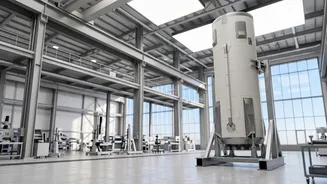
these centres are pivotal for Agnikul's ambitions. STIF is designed to test complete rocket stages, with integrated engines and electronics, under flight-like conditions. Crucially, it also allows for the inspection and requalification of recovered stages, a vital step in making rockets reusable. The PROOF facility brings the manufacturing of essential high-pressure composite vessels in-house, reducing reliance on external suppliers and speeding up production. Together, these facilities give Agnikul end-to-end control over building, testing, flying, recovering, and requalifying its rockets.
Why Reusability Is a Game-Changer
For decades, rockets were a single-use technology. The most expensive parts, the engines and fuel tanks, would burn up in the atmosphere or fall into the ocean after a single launch. This is like building a new airplane for every single flight. Reusable rocket technology, pioneered globally by companies like SpaceX, changes this equation entirely. By designing rocket stages that can land themselves safely back on Earth, they can be refurbished and flown again. This dramatically cuts the cost of accessing space. Cheaper launches mean more satellites can be deployed, opening up opportunities for everything from global internet constellations to more detailed Earth observation, making space access more democratic. For India, mastering this technology is key to becoming a major player in the projected multi-billion dollar global space economy.
Agnikul's Journey and Recent Success
Founded in 2017 at IIT Madras, Agnikul has rapidly become a leading name in India's private space sector. The company's flagship launch vehicle is the Agnibaan, a small-lift rocket designed for payloads up to 100 kg. What makes Agnikul unique is its use of 3D printing to create its semi-cryogenic rocket engines in a single piece, a patented technology that simplifies manufacturing. The company achieved a major milestone on May 30, 2024, with the successful launch of its suborbital mission, 'Agnibaan SOrTeD' (SubOrbital Technological Demonstrator). This test flight was India's first launch from a private launchpad and the first to use a semi-cryogenic engine, proving the viability of their core technologies and setting the stage for future orbital missions.
India's Private Space Ecosystem
Agnikul’s progress does not happen in a vacuum. It is a direct result of India’s strategic push to open the space sector to private enterprise. The establishment of the Indian National Space Promotion and Authorisation Centre (IN-SPACe) has been crucial. IN-SPACe acts as a single-window agency, helping private companies like Agnikul get authorisations, access ISRO's world-class facilities and technical expertise, and facilitate technology transfers. This policy shift allows ISRO to focus on large-scale scientific and strategic missions, while private players drive innovation and commercialisation in areas like small satellite launches. This public-private partnership is designed to help India capture a larger share of the global space market.
The Global Race to Reuse
While Agnikul is making significant strides, it is part of a competitive global race. In the United States, SpaceX has set the benchmark with its Falcon 9 rocket, while companies like Blue Origin, Rocket Lab, and Stoke Space are also developing their own reusable systems. Europe and China are also investing heavily in reusable launch vehicle technology, recognising its strategic importance. Agnikul's new facilities, particularly the unique in-house capability to requalify stages post-flight, position it among a select group of companies worldwide that are building a complete, vertically integrated system for reusable rockets. Its success would not only be a commercial win but also a major technological statement for India.