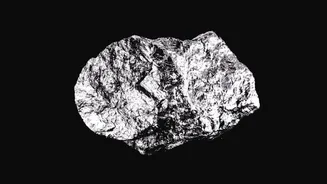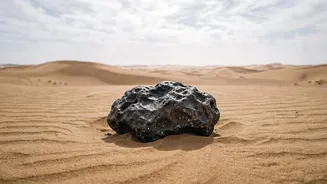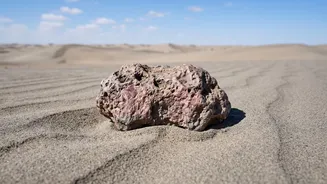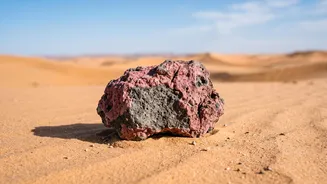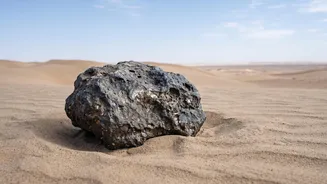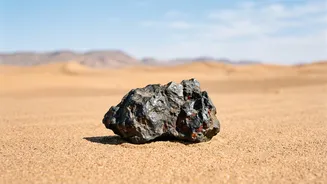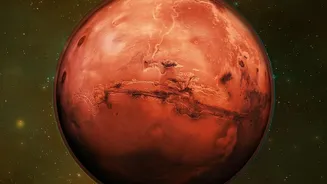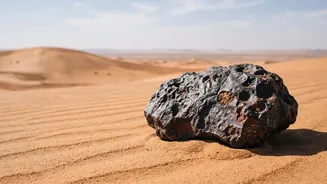



Imagine holding a piece of another world in your hand. A rock, ejected from Mars millions of years ago, that traveled through space to land on Earth. This isn't science fiction; it's the story of Teghaza 001, a time capsule from the Red Planet.
A Messenger From the Red Planet
In 2022,
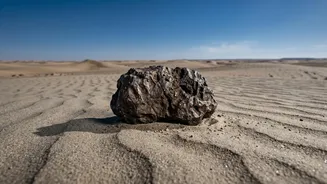
meteorite hunters discovered eight fragments of a distinctive, rose-coloured rock on a salt plain in Mali, within the Sahara Desert. Weighing a total of about 800 grams, the rock was named Teghaza 001 after its discovery location. Initially, scientists thought it might be a common type of Martian meteorite known as a shergottite. But upon closer inspection, researchers realised they had something far more special. One scientist from NASA's Jet Propulsion Laboratory even noted that a reviewer of their research called it a 'Rosetta Stone for Mars'. This was no ordinary space rock; it was a messenger from the dawn of the Red Planet, offering a glimpse into a part of Martian history scientists had never seen before.
The Violent Journey to Earth
So, how does a piece of Mars end up in a desert on Earth? The process is as violent as it is incredible. Billions of years ago, this rock formed as part of the Martian crust from cooling magma. Much later, a powerful asteroid or comet impact slammed into Mars with enough force to blast fragments of the planet's surface into space, overcoming its weaker gravity. Teghaza 001 was one of these fragments. It then likely orbited the sun for millions of years before its trajectory intersected with Earth's. After a fiery descent through our atmosphere, it landed, waiting to be discovered. Scientists can confirm a meteorite's Martian origin by analysing its chemical and mineral composition, especially the isotopes of oxygen, which act like a planetary fingerprint. The gases trapped inside some meteorites can also be matched directly to the Martian atmosphere as measured by probes like the Viking landers.
A 4.1-Billion-Year-Old Time Capsule
What makes Teghaza 001 so extraordinary is its immense age. Using advanced dating techniques on tiny zircon crystals within the rock, scientists determined it formed at least 4.1 billion years ago. This places its creation within the first 400 million years of Mars' existence, making it older than almost any rock found on Earth. It now stands as one of the three oldest Martian meteorites ever found, alongside the famous Allan Hills 84001 (ALH84001). Unlike ALH84001, which is made almost entirely of one mineral, Teghaza 001 is a complex mixture of different igneous minerals. This complexity tells a much richer story about how the planet’s crust was formed and later changed.
A Window into a Watery Past
The secrets locked inside Teghaza 001 point to a very different Mars than the cold, dry world we know today. Analysis shows that the rock was significantly altered by water deep in the Martian crust around 4.1 billion years ago. This indicates that a dynamic water cycle was already in place very early in the planet's history, with water percolating through the subsurface. The find provides some of the strongest evidence yet that primordial Mars was warmer and wetter, conditions that may have been conducive to life. The rock's mineralogy is a unique match for observations made by NASA's Mars Reconnaissance Orbiter of the planet's ancient southern highlands, a region from which we've never had a sample before. Researchers have even identified 13 potential crater locations where this incredible rock might have originated.