

What Exactly Is a Black Hole Star?
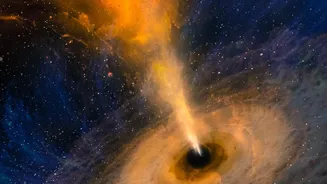
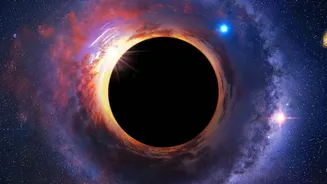
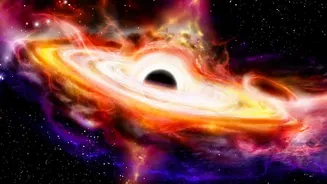
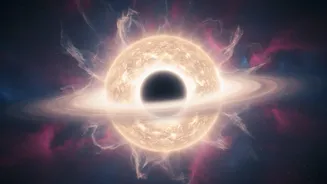
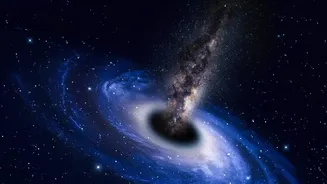
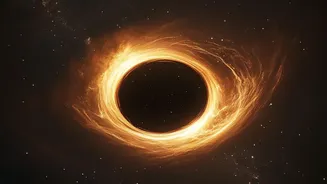
Imagine a star, but instead of a core powered by nuclear fusion like our own sun, it's powered by a black hole. This is the mind-bending concept behind the 'black hole star', also known in theoretical physics as a quasi-star. In a normal star, the outward
pressure from fusion balances the inward pull of gravity. In a black hole star, the incredible energy released by gas and dust falling into the central black hole provides that outward pressure, keeping the massive stellar envelope from collapsing. The result is an object that looks like a colossal, extremely bright star, but is fueled by a completely different and far more violent engine. These objects have been hypothesized to exist only in the early universe, where conditions were right for their formation.
A 'Little Red Dot' Sparks a Big Discovery
The potential discovery was made by astronomers using NASA's James Webb Space Telescope (JWST). While scanning some of the deepest images of the early universe ever taken, they focused on an unusually bright and extremely red object, now named MoM-BH-1. The object, which appeared just 660 million years after the Big Bang, was glowing with the energy of 100 billion suns—far more than any normal star could produce. Its unique light signature, which was intensely red and showed a sharp drop-off in brightness at a specific wavelength, didn't match any known type of star or galaxy. This 'Balmer break', as it's called, was the strongest ever recorded and pointed to a stellar atmosphere unlike any seen before.
Why It's a Star and a Black Hole
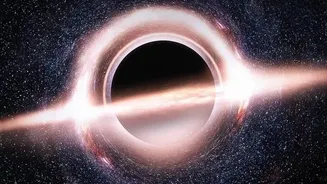
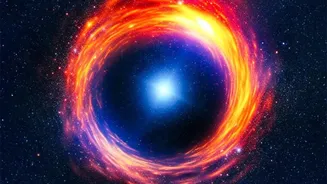
The team from MIT ran computer simulations to figure out what could explain MoM-BH-1's bizarre properties. A normal star, even a supergiant, couldn't generate that much energy. A typical black hole consumes matter through a flat, pancake-like accretion disk, which has a different light profile. The model that fit the data best was a hybrid: a nascent black hole, about 100,000 times the mass of our sun, shrouded in a massive, dense cocoon of hydrogen gas roughly the size of our solar system. This gaseous envelope would radiate light like a star's atmosphere (or photosphere), but it would be powered by the material being consumed by the black hole within. It shines like a star, but its engine is a black hole.
Solving a Cosmic Chicken-and-Egg Problem
The existence of black hole stars could solve one of the biggest mysteries in cosmology: how did supermassive black holes get so big, so fast? We see these behemoths, millions or billions of times the mass of the sun, at the centers of nearly all galaxies, including our own Milky Way. However, they also appear very early in the universe's history, seemingly without enough time to grow so large through standard means. Black hole stars, or quasi-stars, are theorized to be a crucial intermediate step. They would have allowed 'seed' black holes to grow incredibly rapidly in the dense, gas-rich environment of the early cosmos, before eventually shedding their stellar envelopes to become the supermassive black holes we see today. This discovery might be the first direct evidence of that long-theorized process.