

A Trio in the Void
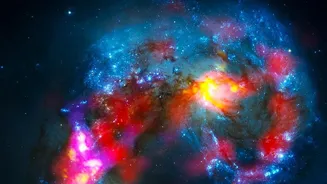
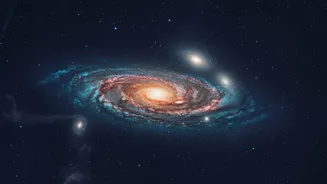
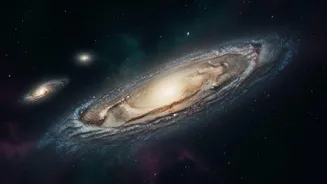
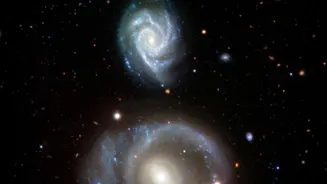
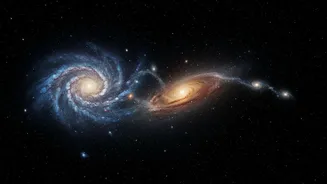
The image in question, capturing a system known as NGC 7764A, is a masterpiece of cosmic portraiture. Located approximately 425 million light-years away in the constellation Phoenix, it presents a scene of immense gravitational drama. In the upper right
of the frame, two spiral galaxies are visibly entangled. Their long, luminous trails of stars and gas are stretched out into the void, a clear sign that they are interacting, their structures warped by each other’s immense gravitational pull. To the left, a third galaxy appears, looking like a spherical, self-contained system. From our vantage point on Earth, it seems to be a part of this chaotic gathering. The immediate impression is that of a connected group, perhaps three galaxies on a collision course or the aftermath of a near-miss. But in astronomy, as in life, appearances can be deceiving.
The Illusion of Proximity
Our view of the universe is fundamentally two-dimensional. Telescopes like Hubble capture light from objects, but they don't inherently reveal their depth in the cosmic ocean. This leads to what astronomers call 'line-of-sight' alignments or 'visual coincidences.' An easy way to understand this is to hold your thumb up to the Moon. From your perspective, your thumb might appear to be the same size as or even larger than the Moon, and right next to it. You know, however, that your thumb is inches from your face while the Moon is hundreds of thousands of kilometres away. The same principle applies to galaxies. Two galaxies might appear side-by-side in an image, but one could be millions of light-years behind the other. Disentangling these chance alignments from genuine, gravitationally bound groups is one of the fundamental challenges of mapping the cosmos.
Partners, Neighbours, or Strangers?
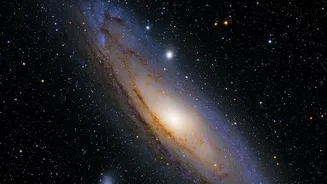
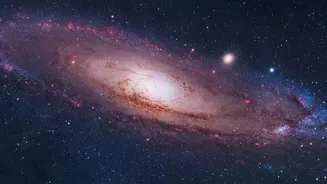
In the case of NGC 7764A, we know for certain that two of the galaxies are true partners. The distorted shapes and the bridge of stars connecting them are undeniable evidence of a powerful gravitational interaction that has been unfolding over hundreds of millions of years. They are in the process of a slow-motion merger, a common event in the life cycle of galaxies. Our own Milky Way is predicted to merge with the Andromeda galaxy in about 4.5 billion years. The third galaxy in the image presents more of a puzzle. While it looks relatively close to the interacting pair, astronomers cannot be certain of its relationship without more data. It could be a true companion, gravitationally linked to the other two. Alternatively, it could be a complete stranger—either a foreground galaxy much closer to us or a background galaxy much farther away—that just happens to lie along the same line of sight.
Measuring the Cosmic Distances
So, how do astronomers solve this cosmic mystery? The key tool is 'redshift.' As the universe expands, it stretches the light waves travelling through it. Light from distant galaxies is stretched to longer, redder wavelengths by the time it reaches our telescopes. By measuring the specific redshift of a galaxy, scientists can calculate how far away it is and how fast it is receding from us. This technique allows them to build a three-dimensional map of the universe from flat images. By measuring the redshift of all three galaxies in the NGC 7764A system, astronomers can determine if they all lie at the same distance. If their redshifts are similar, they are likely a true trio. If one galaxy has a significantly different redshift, it confirms that it's just a cosmic photobomber.