







A New Rocket for a Special Job
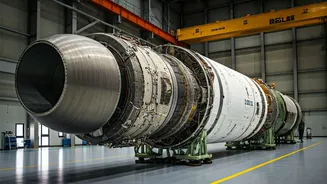
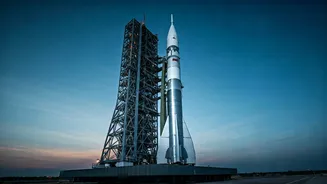
Contrary to what its name might suggest, SOLVE isn't a complex software but a physical rocket: the Sub-Orbital Launch Vehicle for Experiments. Think of it not as the final ride to orbit, but as a dedicated, purpose-built test platform. On July 3, 2026,
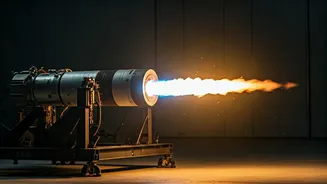
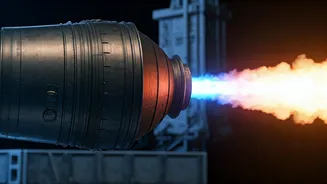
the Indian Space Research Organisation (ISRO) successfully conducted the first ground test of SOLVE's solid motor at the Satish Dhawan Space Centre in Sriharikota, with all performance parameters meeting their targets. This new vehicle has one crucial job: to help perfect the landing system for the Gaganyaan crew module, the capsule that will carry India's astronauts back to Earth. It is a key piece of the safety puzzle, designed for the sole purpose of rigorous testing.
Mastering the Final Descent
Returning from space is one of the most perilous parts of any human spaceflight mission. The crew module, travelling at immense speeds, must decelerate dramatically for a safe splashdown. For Gaganyaan, ISRO has designed a sophisticated deceleration system that relies on a complex, precisely timed sequence of 10 different parachutes. This chain of events must work flawlessly, starting with smaller drogue parachutes to stabilize the capsule and followed by massive main parachutes to slow it down for a gentle landing in the sea. Validating such a multi-stage system is incredibly complex, as it needs to be tested under conditions that accurately mimic a real return from orbit. Failure at this stage is not an option, making thorough testing paramount.
A Purpose-Built Test Platform
This is where SOLVE comes in. The rocket is designed to carry a test version of the Gaganyaan crew module to a sub-orbital altitude of between 10 and 17 kilometres before releasing it. From this height, the module will begin its descent, allowing engineers to trigger and monitor the entire parachute deployment sequence in a controlled, real-world environment. The development of SOLVE gives ISRO a flexible and repeatable way to conduct these crucial integrated parachute tests. It allows them to simulate a wide range of conditions and potential scenarios, ensuring the entire deceleration and recovery system is robust and reliable long before the first astronaut straps in for a real mission.
Proven Technology, New Purpose
In a display of its signature frugal and efficient engineering, ISRO has based the SOLVE rocket on proven technology. Its solid stage is cleverly derived from the strap-on booster motors used in the workhorse Polar Satellite Launch Vehicle (PSLV), one of the most reliable rockets in the world. However, it's not a simple copy-paste. The motor has been significantly modified for its new role, incorporating a slower-burning propellant and a new nozzle with a secondary injection thrust vector control system. These changes are specifically designed to meet the flight requirements for a sub-orbital test mission, creating a vehicle that is just powerful enough for the job, making it a cost-effective and highly specialized tool for enhancing astronaut safety.
One Step Closer to Crewed Flight
The successful ground test of SOLVE is more than just a technical achievement; it represents a significant step forward in the massive undertaking that is the Gaganyaan mission. Before India sends its 'Vyomnauts' to space, ISRO has planned a series of uncrewed test flights to validate every single system. The ability to thoroughly test the parachute system—arguably one of the most critical safety components—using a dedicated vehicle like SOLVE builds immense confidence in the overall mission architecture. Each successful test of a component like this brings India closer to its dream of human spaceflight, reinforcing a safety-first philosophy that ensures the nation's ambitions in space are matched only by its commitment to protecting its astronauts.