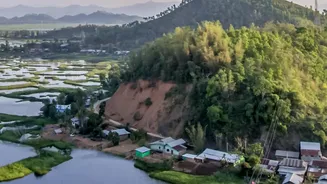




Imagine a national park that isn't on solid ground, but floats. In the heart of Manipur lies Keibul Lamjao, a breathtaking marvel of nature that holds the unique title of being the only floating national park in the entire world.
An Ever-Shifting Mosaic
Keibul Lamjao National
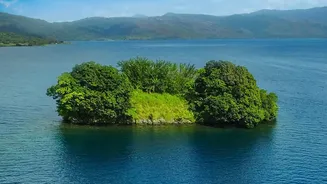
Park is an integral part of Loktak Lake, Northeast India's largest freshwater lake. What makes the park float are the 'phumdis'—a local Meitei term for the dense, tangled mats of vegetation, soil, and organic matter in various stages of decay. These phumdis are not just wisps of grass; they can be up to two meters thick, forming solid-looking islands of green that drift on the water's surface. Covering an area of 40 square kilometres, the park is a living, breathing ecosystem where the very ground beneath your feet is a buoyant, ever-shifting mosaic. This unique geography, part marsh and part lake, exists nowhere else on the planet, making it a true natural wonder.
Home of the 'Dancing Deer'
The park's most famous resident is the Sangai, the graceful brow-antlered deer that is also the state animal of Manipur. This species is critically endangered and Keibul Lamjao is its last remaining natural refuge in the world. The Sangai is often called the 'dancing deer' because of its delicate, rhythmic gait as it navigates the soft, yielding phumdis. To keep its balance on the spongy, moving ground, the deer has to tread carefully, creating a motion that resembles a beautiful, slow dance. Once believed to be extinct in 1951, a small population was rediscovered in 1953, which led to the creation of the sanctuary in 1966 and its designation as a national park in 1977.
A Delicate Balancing Act
The existence of the phumdis depends on a natural cycle. During the dry season, the water level of Loktak Lake would traditionally drop, allowing the phumdis to touch the lakebed and absorb nutrients from the soil. However, the construction of the Ithai Barrage for a hydroelectric project in 1983 has kept the water level high year-round. This permanent flooding prevents the phumdis from anchoring and feeding, causing them to thin out and break apart. A phumdi needs to be at least one metre thick to support the weight of an adult Sangai, but many are now too weak, posing a direct threat to the deer's survival.
Life on the Floating Islands
Keibul Lamjao is not just a sanctuary for wildlife; it's also intertwined with human life. Local fishermen have lived on the phumdis for generations, building small huts called 'phumshangs'. They rely on the lake for their livelihood, practicing fishing and aquaculture. Some even create artificial, circular phumdis called 'athapums' for fish farming. This close relationship between humans and the ecosystem highlights the cultural significance of Loktak Lake, which is revered as a 'mother' providing life to the people of Manipur. The park is also steeped in local folklore and is a site of cultural pride, with its potential recognition as a UNESCO World Heritage Site currently under consideration.
An Ecosystem Under Pressure
Today, this unique ecosystem faces a multitude of threats. Besides the thinning of the phumdis, the lake suffers from pollution due to agricultural runoff and waste from surrounding settlements. This degradation of water quality harms the fish populations and the overall health of the habitat. The very survival ofthe Sangai is at a critical juncture, with recent studies suggesting a decline in any wild population and threats of inbreeding due to their isolation. Conservation efforts are underway, but the struggle to balance human development with the preservation of this fragile environment is immense. The fate of any world's only floating park hangs in a delicate balance, requiring urgent and sustained action.