





Meet the Cosmic Ghost
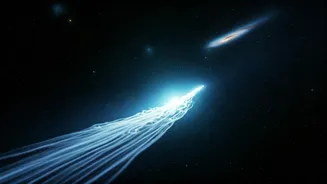
Imagine a particle so ethereal it can pass through light-years of solid lead without hitting a thing. Trillions of them are streaming through your body right now, completely unnoticed. This is the neutrino, the ghost particle of the cosmos. Neutrinos
are fundamental particles with almost no mass and no electric charge, meaning they barely interact with other matter. This aloof nature makes them incredibly difficult to detect, but it also makes them perfect cosmic messengers. While light can be blocked by gas and dust, neutrinos travel across the universe unimpeded, carrying pristine information from the most violent and energetic events, like exploding stars and the regions around supermassive black holes. For years, a major puzzle has been the origin of the highest-energy neutrinos, which possess millions of times more energy than those produced by our sun. Finding their sources would open a new window onto the universe's most extreme environments.
The Search for a Source
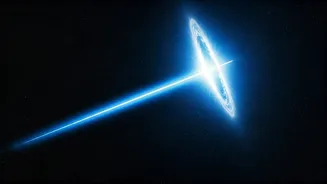
To catch these elusive particles, scientists built the IceCube Neutrino Observatory, a massive telescope buried a kilometre deep in the Antarctic ice. Its sensors monitor a cubic kilometre of ice, waiting for the rare flash of light produced when a neutrino finally collides with an atom. In 2018, IceCube had a major success, tracing a high-energy neutrino back to a 'blazar'—a galaxy with a supermassive black hole at its centre that spews a powerful jet of particles and radiation directly at Earth. Blazars became the prime suspects in the neutrino mystery. The theory was that these bright, powerful jets were the cosmic particle accelerators responsible for creating high-energy neutrinos. However, blazars alone couldn't account for all the neutrinos IceCube was detecting, suggesting other types of sources were still hiding.
An Unexpected Witness Appears
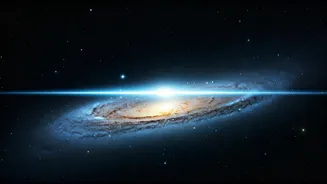
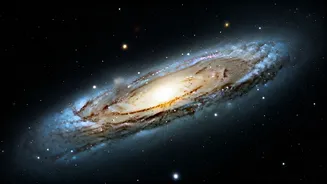
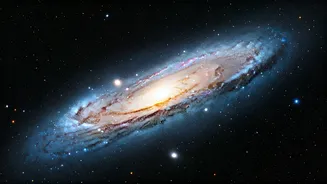
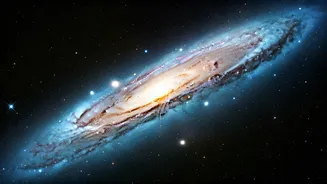
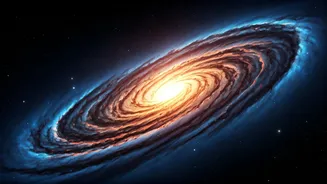
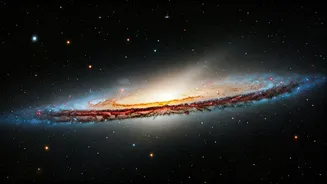
The latest breakthrough comes from a completely different type of galaxy: NGC 1068, also known as Messier 77. Located 47 million light-years away, it’s a familiar object to astronomers. Like a blazar, it has an active supermassive black hole at its core, but with a crucial difference. Its centre is shrouded in a thick torus, or doughnut, of dust and gas, and its jet is not pointed towards us. Using years of data, scientists at IceCube were astonished to find a significant stream of about 80 high-energy neutrinos coming from the direction of NGC 1068. What made this so shocking was that this galaxy is not a powerful source of gamma rays, the high-energy light that was expected to accompany neutrino production. This finding challenged the existing models and pointed to a new mechanism at work.
The Dust Is the Key
The mystery of the missing gamma rays turned out to be the most important part of the clue. Scientists now believe that the very dust and gas obscuring the galaxy's core are essential to the process. In this model, the region around the black hole acts as a colossal, hidden particle accelerator. Protons are whipped up to incredible speeds and then crash into the dense cloud of surrounding gas—the dusty torus. These collisions create a shower of secondary particles, including neutrinos and gamma rays. But while the ghostly neutrinos escape unhindered, the gamma rays are trapped and absorbed by the thick dust. This explains why IceCube sees the neutrinos, but gamma-ray telescopes see nothing. The dusty core isn't just hiding the action; it's a fundamental part of the engine creating the neutrinos.
A New Chapter in Astronomy
The discovery of NGC 1068 as a neutrino source is a landmark achievement. It confirms a new type of cosmic object—dust-obscured active galaxies—as neutrino factories. This suggests there could be a whole population of similar galaxies across the universe, collectively producing the diffuse background of high-energy neutrinos that scientists have been detecting for years. This breakthrough is a major step forward for multi-messenger astronomy, an approach that combines information from different cosmic messengers—light, neutrinos, and gravitational waves—to get a complete picture of an event. By using neutrinos to peer into the hidden hearts of galaxies like NGC 1068, places that light cannot escape from, astronomers can now study the physics of supermassive black holes in a way that was previously impossible.