



The Payload Penalty
The primary business of any launch vehicle is to deliver a payload to a specific orbit. Every kilogram dedicated to anything other than that payload is a kilogram that a customer cannot launch. Reusability, for all its long-term cost benefits, comes with
a significant upfront performance cost known as the 'payload penalty'. To land, a rocket booster must reserve a substantial amount of propellant for its descent and landing burns. This is fuel that cannot be used to push the payload further, higher, or faster. Furthermore, the booster must be equipped with landing legs, grid fins for steering, and reinforced structures to withstand reentry and landing stresses. All this hardware adds mass. For a SpaceX Falcon 9, flying in an expendable mode where the booster is discarded allows it to carry about 22,800 kg to low Earth orbit. When it must land on a drone ship, that capacity drops to around 17,500 kg. If it needs to perform a more fuel-intensive return to the launch site, the payload capacity is even lower. This trade-off is the central economic challenge: companies accept a lower payload per flight because the immense cost savings from reusing the booster make it worthwhile for most missions.
The Quest for Pinpoint Accuracy
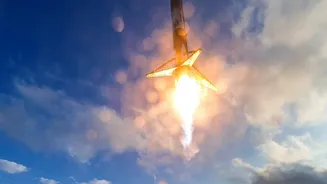
A reusable rocket is useless if it cannot land on the recovery platform, whether it's a concrete pad on land or a robotic drone ship at sea. Achieving this requires incredible precision. The rocket booster, after separating from the second stage, must autonomously perform a series of complex manoeuvres to guide itself back to a target that can be hundreds of kilometres away. This is where advanced control systems come into play. On the Falcon 9, for example, four large titanium grid fins deploy to steer the booster during its atmospheric descent, making tiny adjustments to control its orientation and trajectory. These fins are primarily responsible for the rocket's incredible landing accuracy. The rocket's own engines are then used for the final braking and touchdown burns. Early attempts by SpaceX saw landing accuracies of about 10 kilometres, but continuous refinement of the hardware and software has improved this to within metres. Landing at sea adds another layer of complexity, as the drone ship itself must be precisely positioned to meet the incoming rocket. The drive for accuracy is relentless, as a miss not only means the loss of a multi-million dollar booster but also poses a safety risk.
The Uncompromising Demand for Safety
Above all else, a rocket mission must be safe. This applies to the payload (especially if it is carrying humans), personnel on the ground, and the general public. Rocket recovery introduces new safety considerations. The descent and landing phases are inherently risky. A failure in the control system, an engine not relighting correctly, or unexpected atmospheric conditions can cause the booster to veer off course. This is why landing zones, both on land and at sea, are located in carefully selected areas with large exclusion zones. Should a rocket go catastrophically wrong during any phase of flight, a Range Safety Officer has the authority to issue a command to the rocket's Flight Termination System (FTS), which destroys the vehicle to prevent it from endangering a populated area. Even a successful landing carries risks. The booster is a complex piece of machinery that has just endured extreme forces and temperatures. Safety protocols for securing the landed stage, venting residual propellants, and transporting it are extensive. For crewed missions, the safety requirements are even stricter, influencing every aspect of the rocket's design and recovery procedure.
A Three-Way Balancing Act
These three factors—payload, accuracy, and safety—are in a constant state of tension. Improving one often comes at the expense of another. For instance, increasing the payload to orbit requires using more fuel for the ascent, leaving less in reserve for landing manoeuvres. This might force a company to choose a less-demanding drone ship landing instead of a return-to-launch-site landing, which accepts a higher risk and lower accuracy in exchange for higher performance. Enhancing safety might involve adding redundant systems or wider abort corridors, which adds mass and reduces the payload capacity. Conversely, striving for higher landing accuracy might require more sophisticated sensors and control surfaces, again adding weight and slightly reducing the payload lift capability. Companies like SpaceX and Blue Origin are constantly refining this balance. Their success in the modern launch market is not just about building powerful rockets, but about mastering this intricate dance of trade-offs to provide reliable, cost-effective, and safe access to space.