







Meet the Milky Way's First 'Microblazar'
The object at the heart of this cosmic drama is known as IRAS 18293-0941. For decades, astronomers have theorized that our galaxy should be home to miniature versions of powerful objects called 'blazars', which are supermassive black holes in distant
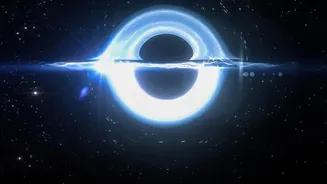
galaxies whose jets point directly at us. This recent discovery is the first convincing candidate for such a 'microblazar' in the Milky Way. It's a binary system where a black hole, about ten times the mass of our sun, is locked in a fast, 11-day orbit with a massive companion star. The black hole's immense gravity strips gas from the star, creating a superheated disc of material around itself.
What Is a Black Hole Jet?
Not all the material stolen from the companion star falls into the black hole. A portion of this superheated gas gets caught in powerful magnetic fields and is channeled away from the black hole's poles. This process launches two narrow, opposing jets of plasma—a state of matter so hot that electrons are stripped from their atoms—out into space at incredible speeds. In the case of IRAS 18293-0941, these jets travel at about 75% of the speed of light. Because one of these jets is aimed almost directly at us, a phenomenon called 'relativistic beaming' or 'Doppler boosting' makes it appear significantly brighter than its counterpart, much like the siren of an approaching ambulance sounds higher-pitched. The other jet remains invisible until it slams into a distant molecular cloud.
An Astronomical Detective Story
Finding this microblazar was no easy task. The system is located 12,000 light-years away in the constellation Scutum, shrouded by such dense interstellar dust that it's essentially invisible in normal optical light. Astronomers first catalogued the object decades ago but it was largely forgotten. The breakthrough came when researchers, using multiple radio telescopes like the European VLBI Network and South Africa’s MeerKAT array, pieced together the clues. They confirmed that the jet originated from the star system and not a background galaxy. They also detected a vast bubble, about 100 light-years across, carved out by the receding jet as it collides with a cloud of gas, creating a glowing hotspot.
An Extraordinary Lab, Not a Threat
So, should we be worried? The simple answer is no. A distance of 12,000 light-years is astronomically vast; for perspective, the nearest star to our sun is just over four light-years away. The jet has been firing for thousands of years, and by the time any of its particles cross that immense distance, they have spread out and faded into nothing. The system poses no realistic hazard to Earth. Instead, astronomers are thrilled. Previously, all known blazars were in distant galaxies, millions or billions of light-years away, making them difficult to study in detail. IRAS 18293-0941 is a cosmic laboratory in our own galactic backyard.
Why This Discovery Is a Big Deal
This microblazar offers an unprecedented opportunity to understand some of the most violent physics in the universe. It allows scientists to study how these jets are launched, how they are shaped, and how they interact with their surroundings on much shorter timescales than their supermassive cousins. Furthermore, the point where the receding jet crashes into the molecular cloud is a site of extreme particle acceleration, creating energies far beyond what can be achieved in humanity's most powerful particle accelerators. Scientists speculate that these kinds of systems could be the source of some of the ultra-high-energy cosmic rays that rain down on Earth, a long-standing cosmic mystery. This discovery opens a new window into the universe's most powerful engines.