








The Unprecedented Power Demand of AI
Traditional data centres were built for a different era of computing. Their tasks, like hosting websites or cloud storage, are demanding but predictable. AI is a different beast entirely. Training large AI models involves running specialized hardware,
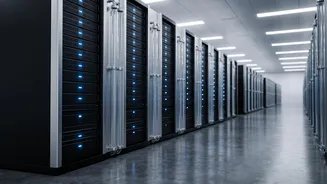
like Graphics Processing Units (GPUs), at maximum capacity for extended periods. Compared to traditional Central Processing Units (CPUs), which use around 150-200 watts per chip, modern GPUs can consume 700-1,200 watts each. An AI server rack can require 50-100 kilowatts (kW) of power, a staggering jump from the 7-12 kW needed for a conventional rack. This high-density computing generates an immense amount of heat in a very small space, rendering traditional cooling methods inadequate and inefficient.
Measuring Efficiency: The PUE Metric
In the data centre world, the key metric for efficiency is Power Usage Effectiveness (PUE). It's a simple ratio: the total power consumed by a facility divided by the power delivered to the IT equipment. An ideal PUE would be 1.0, meaning every single watt of energy goes directly to computing tasks with none wasted on overhead like cooling or power conversion. In reality, this is impossible. The global average PUE is around 1.5, meaning for every two watts powering the servers, one watt is used for cooling and other infrastructure. The intense power draw and subsequent heat from AI workloads can send the PUE of a poorly designed facility soaring, wasting enormous amounts of electricity and money.
The Rise of Liquid Cooling
For decades, data centres have been cooled by air, essentially running like giant, high-tech refrigerators. But air is not a very efficient medium for heat transfer, especially when dealing with the concentrated heat from AI hardware. This has forced the industry to embrace a technology that has been around for a while but is now becoming essential: liquid cooling. Innovations like direct-to-chip liquid cooling involve circulating fluid through plates attached directly to the heat-producing chips, carrying warmth away far more effectively than air. Another method, immersion cooling, involves submersing entire servers in a non-conductive liquid. These systems are not only more efficient at cooling but can also significantly reduce a data centre's water and energy consumption.
Smarter, Not Just Cooler
Efficiency is not just about cooling. The AI challenge is sparking innovation across the entire data centre stack. Ironically, AI itself is being used to make data centres more efficient. AI-powered management systems can predict energy demand, dynamically adjust cooling in real-time, and shift computing jobs to optimize power usage across thousands of servers. Hardware manufacturers are designing more energy-efficient chips and server architectures. Furthermore, data centre operators are getting smarter about site selection, building in cooler climates to take advantage of 'free cooling' from the outside air and co-locating facilities near renewable energy sources to reduce their carbon footprint.
India's High-Stakes Efficiency Race
This global shift has profound implications for India, which is on the cusp of a massive data centre boom. Driven by the digital economy and AI adoption, India's data centre capacity is projected to surge from 1.6 GW in mid-2026 to 6 GW by 2029, making it Asia's fastest-growing market. Some forecasts predict the capacity could reach 12 GW by 2030. This expansion, particularly in hubs like Mumbai, Hyderabad, and Chennai, will be heavily influenced by AI workloads. For India, building these new data centres with a focus on efficiency is not just an option; it's a necessity. It's crucial for managing the strain on the nation's power grid, ensuring sustainable growth, and establishing India as a globally competitive leader in digital infrastructure.