







An Indian Achievement in Planetary Science
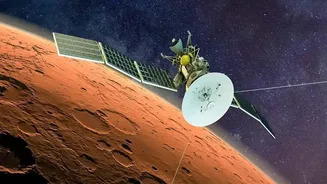
Researchers from the Physical Research Laboratory (PRL) in Ahmedabad have charted the complex climate behaviour of the Red Planet. Their study, published in the journal Current Science, used advanced infrared data from the Emirates Mars Mission's 'Hope'
spacecraft to analyse two of Mars's largest and most dramatic geological features: the Hellas and Argyre impact basins. This work builds on a legacy of Indian contributions to Martian science, including years of valuable data gathered by ISRO's own Mars Orbiter Mission (Mangalyaan). By focusing on these massive basins, the PRL scientists were able to get an unprecedented look at how the planet's surface topography influences its atmospheric patterns.
Decoding the Red Planet's Wild Weather
The PRL team's work revealed just how extreme the Martian climate can be. Surface temperatures can swing wildly from a relatively balmy 22°C down to a frigid -123°C. This is largely because Mars's thin atmosphere is not good at holding onto or distributing heat, unlike Earth's much thicker blanket of air. As a result, the surface heats up fast in the sun and cools down just as quickly when it sets. The planet’s elliptical orbit adds another layer of complexity. Mars is closest to the Sun during its southern hemisphere's summer, making that season significantly more intense. The PRL study noted that temperatures in some southern regions were about 25 Kelvin (or 25°C) higher than in the north during the same season, a crucial factor in driving the planet's weather.
So, What Are Zonal Waves?
The most fascinating part of the discovery isn't just the temperature swings, but how heat moves across the planet. The scientists observed that thermal energy travels in huge, structured patterns known as zonal waves. Think of these not as waves on water, but as massive, planet-girdling ripples in the atmosphere that travel horizontally along lines of latitude. On Earth, these waves (often called Rossby waves) are crucial to our weather, moving heat from the tropics towards the poles and influencing the path of the jet stream. On Mars, these zonal waves offer a window into the planet's hidden atmospheric circulation. They are like seeing ripples on a pond, which tells you about the currents moving underneath the surface.
A Tale of Two Basins
The PRL scientists found that the shape of the Martian surface plays a huge role in forming these waves. They observed a striking difference between the two giant basins they studied. The Argyre basin was dominated by a simple, large-scale pattern called a 'wave-1' pattern. Meanwhile, the much deeper and larger Hellas basin showed more complex 'wave-2' and 'wave-3' patterns, which changed with the seasons. This confirmed that the intense, uneven solar heating combined with the unique topography of these deep basins is what generates and shapes these complex waves, giving scientists a powerful new tool to understand how the Martian climate machine works.
Why This Discovery Matters for Future Missions
This research is more than just an academic curiosity; it has profound practical implications for the future of Mars exploration. Understanding the Red Planet’s atmospheric dynamics, including its temperature extremes and wave patterns, is vital for safely landing and operating robotic and eventually human missions. Sudden shifts in atmospheric density, driven by these temperature waves, can throw a descending spacecraft off course. Furthermore, building any kind of permanent habitat will require precise knowledge of the thermal stresses that equipment and astronauts would face. By mapping these waves, the Indian scientists have provided crucial data that will help refine our climate models—the study noted that current models were often about 10 Kelvin too cool compared to the real-world measurements—and ensure the safety of the next generation of Martian explorers.