





Our Galaxy’s Quiet Giant
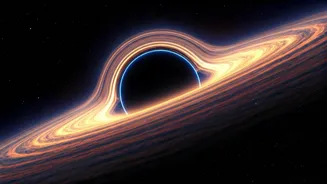
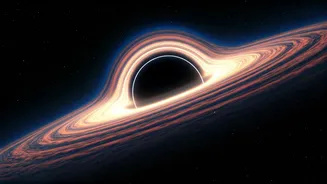
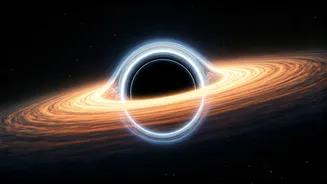
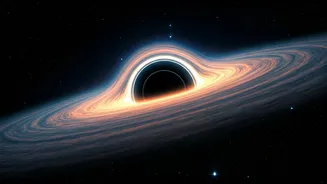
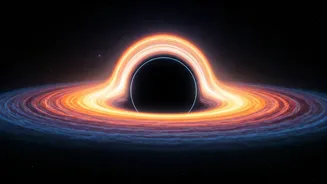
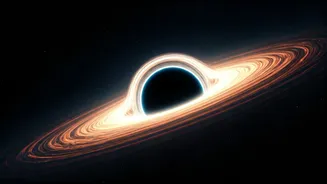
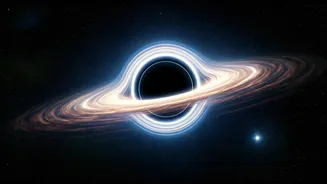
Sagittarius A, or Sgr A for short, is the supermassive black hole at the center of our galaxy, located about 26,000 light-years from Earth. While it sounds intimidating, Sgr A is actually considered a relatively gentle giant. Compared to the ferociously
active black holes (known as active galactic nuclei, or AGNs) seen in other galaxies, ours is remarkably quiet. It consumes very little material; one scientist compared its diet to a human eating a single grain of rice every million years. Because of this low activity and the fact that our view is obscured by the gas and dust of the Milky Way's plane, studying it up close is incredibly challenging. This faintness is why a key feature predicted by theory—a wind of outflowing material—remained hidden for decades.
The Mystery of the Missing Stars
The area around Sgr A has presented a long-standing puzzle for astrophysicists. The galactic center is packed with vast clouds of cold gas and dust—the raw ingredients needed to form new stars. Yet, for some reason, the rate of star formation there is surprisingly low. Something has been preventing this gas from collapsing and igniting into new suns. For years, scientists suspected that outflows from the black hole itself could be the culprit, a process known as "astrophysical feedback." This feedback mechanism is thought to be a crucial way that black holes regulate the growth of their host galaxies. However, without direct evidence of a wind from Sgr A, it was just a compelling theory.
Catching an Invisible Wind
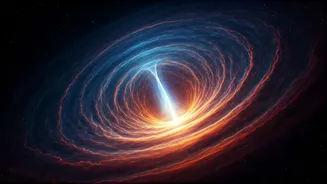
After a half-century search, an international team of researchers finally found what they were looking for. By combining over five years of observations from the Atacama Large Millimeter/submillimeter Array (ALMA) in Chile and data from NASA's Chandra X-ray Observatory, they created the sharpest and deepest map ever of the gas surrounding Sgr A. The data revealed a stark, cone-shaped cavity in the cold gas, about three light-years across. This void could not be explained by the winds from surrounding stars alone; the energy required to carve it out was too immense. The only logical explanation was a persistent wind blowing from the black hole itself, which has likely been active for at least 20,000 years. Scientists couldn't see the wind directly, but they saw the dramatic footprint it left behind, like seeing an invisible person's path through a snowstorm.
How a Black Hole Shapes Its Galaxy
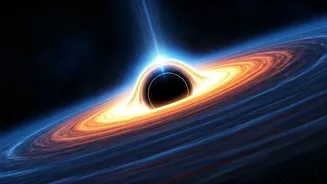
This discovery provides the first clear evidence of how even a quiet black hole actively shapes its environment. The wind emanating from Sgr A acts like a cosmic leaf blower, pushing away the surrounding gas or heating it up. When the gas is too hot or is physically pushed out of the immediate area, it can no longer cool and clump together to form stars. This process effectively puts the brakes on star birth in the galactic center. This finding demonstrates that black holes are not just passive drains that swallow matter, but are active participants in a life cycle that governs their host galaxy. By expelling gas, the black hole regulates its own food supply and, in doing so, controls the pace of star formation in its neighborhood.
A Window into Cosmic Evolution
The confirmation of a wind from Sgr A is significant because it shows that our galaxy's black hole is not a unique outlier; it behaves just like its more active cousins in distant galaxies, only on a much gentler scale. Most supermassive black holes across the universe are thought to be in a quiet state for most of their lives. Sgr A therefore provides a perfect local laboratory to study this dominant, but rarely seen, phase of a black hole's life. Understanding this gentle feedback process in our own cosmic backyard helps scientists refine their models of how all galaxies, including the Milky Way, have grown and evolved over billions of years. It fills a major gap in our understanding of the delicate balance between a black hole and its galactic home.