

A Cosmic Trio in a Single Frame
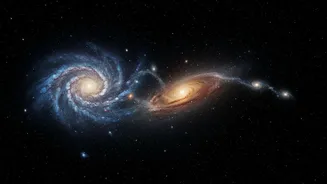
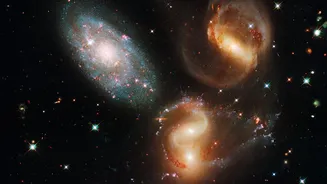
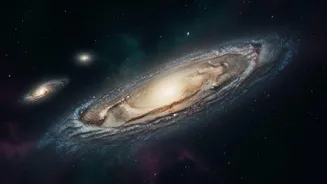
The Hubble Space Telescope recently captured a striking portrait of what appears to be three galaxies locked in a cosmic dance. Known collectively as NGC 7764A, this group is located approximately 425 million light-years from Earth in the constellation
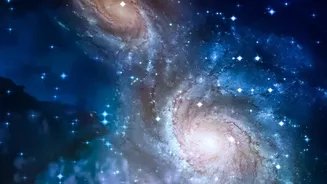
Phoenix. In the image, two spiral galaxies to the upper right seem to be interacting, their forms distorted and trailing long streams of stars and gas. This gives the dramatic impression of a high-speed collision. To the lower left, a third, rounder galaxy looks like a bowling ball that has just caused the cosmic strike. The image, taken by Hubble’s powerful Advanced Camera for Surveys and Wide Field Camera 3, is visually spectacular, but it also poses a fascinating question for astronomers.
The Illusion of Proximity
The phrase “apparent closeness” is key to understanding images like this. Just because objects appear side-by-side from our viewpoint on Earth does not mean they are true neighbours in space. This is a common challenge for observational astronomers: determining whether they are seeing a genuine interacting system or a chance alignment along our line of sight. Think of it like a photograph where a tourist in the foreground appears to be holding the Taj Mahal in their hand. We know they are separated by a great distance, but the two-dimensional image creates an illusion. Similarly, one galaxy might be millions of light-years behind another, but from our perspective, they look like partners. Astronomers have to use other tools to uncover the truth of their relationship.
True Companions vs. Ships in the Night
In the case of NGC 7764A, the two galaxies in the upper right do indeed appear to be interacting. The gravitational tug-of-war between them is slowly reshaping their structures, a process that can take up to half a billion years. Their distorted shapes and the starry tails are tell-tale signs of a genuine galactic merger in progress. However, the relationship of the third, “bowling-ball” galaxy is less certain. While it appears close enough to be part of the interaction, astronomers cannot yet confirm if it is a true member of the group or simply a background object that happens to align perfectly in Hubble’s view. Similar studies of other galactic groups, such as Arp-Madore 2339-661, have revealed that what looks like a pair can actually be a trio, with a smaller dwarf galaxy hiding within the arms of a larger one.
How Astronomers Measure Cosmic Distances
So, how do scientists tell the difference between a real galactic pair and a cosmic illusion? The primary method involves measuring an object's redshift. As the universe expands, distant objects move away from us, causing the light they emit to stretch to longer, redder wavelengths. By analyzing the light from a galaxy, astronomers can calculate its redshift and, from that, its velocity and distance. If two galaxies show a similar redshift, it's a strong indicator that they are at a similar distance and are likely true companions. In the case of one galactic trio, analysis revealed that a knot-like structure in one galaxy’s arm had a different velocity, proving it was a separate entity. This technique allows astronomers to build a three-dimensional map of the cosmos and distinguish between interacting systems and mere optical alignments.
Why These Observations Matter
Studying both genuinely interacting galaxies and visual alignments is crucial for understanding how galaxies evolve. Mergers are a fundamental process in the universe; they trigger massive bursts of star formation and are how large galaxies, including our own Milky Way, have grown over billions of years. By observing these collisions at various stages, scientists can refine their models of galaxy formation and the life cycle of stars. Conversely, identifying and discounting optical pairs is just as important. It prevents scientists from drawing incorrect conclusions about galactic interactions and helps to create a more accurate census of the universe. Images like that of NGC 7764A are not just beautiful; they are cosmic laboratories that test our understanding of gravity, motion, and the vast architecture of space.