






A Tale of Two Worlds
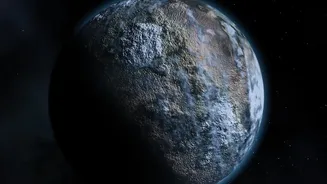
Astronomers recently turned their gaze toward a star system 48 light-years away and found a perfect natural experiment. The star, a red dwarf named LHS 1140, hosts multiple planets. One of them, LHS 1140 b, is a super-Earth — a rocky world larger than
our own. Scientists detected a faint wisp of helium gas escaping from this planet. Ironically, this leak is cause for celebration; it is the first definitive proof of an atmosphere around a rocky planet in its star's habitable zone. But the story gets more interesting. The system has another planet, LHS 1140 c, which orbits much closer to the star. It receives far more radiation and, according to the new observations, it has no detectable atmosphere at all. It appears to be a barren, airless rock, its gaseous envelope likely stripped away long ago.
The Science of Atmospheric Stripping
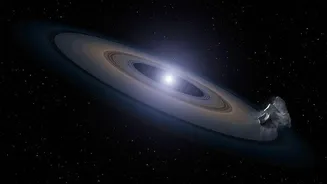
The fate of these two sibling planets provides a dramatic illustration of a process called photoevaporation. Think of a star as a relentless, high-powered hairdryer. It constantly emits a torrent of high-energy radiation, including X-rays and ultraviolet light, along with a stream of charged particles known as stellar wind. For a planet orbiting nearby, this radiation heats the upper layers of its atmosphere. The gas particles become so energized that they can escape the planet's gravity and fly off into space. This process is especially brutal around red dwarf stars like LHS 1140, which are smaller than our sun but can be ferociously active, particularly in their youth, unleashing powerful flares that can erode a planet’s atmosphere with extreme prejudice.
Redefining the Habitable Zone
This discovery forces a critical update to our search for life. For decades, the “habitable zone” has been defined primarily by temperature — the orbital region where a planet could host liquid water on its surface. But the story of LHS 1140 b and c shows that proximity isn’t everything. A planet can be in the perfect temperature range, but if it can't hold onto its atmosphere, it will never be truly habitable. The survival of LHS 1140 b’s atmosphere for billions of years is a landmark finding. It suggests that despite the violent nature of red dwarf stars, some rocky worlds can successfully weather the storm. This gives astronomers renewed hope, because red dwarfs are the most common type of star in our galaxy, and this discovery means the vast number of planets orbiting them can't be written off as uninhabitable just yet.
Finding the Atmospheric Sweet Spot
The evolution of a planet's atmosphere is a delicate balancing act. Lose too much, and you become a cold, dead world like Mars. But retaining too much of the primordial hydrogen and helium gas from formation isn't ideal either; this leads to a “mini-Neptune,” a gassy planet without a solid surface. The goal is to find rocky worlds that have lost their initial thick shroud but have held onto a heavier, secondary atmosphere created by geological activity, much like Earth did. The escaping helium from LHS 1140 b might be a sign that it is in this exact transitional sweet spot. It likely shed a huge, puffy early atmosphere and has settled down with a more compact one that it has managed to maintain for eons. Observing this process in action allows scientists to test their models and better understand what makes a planet a survivor.