






An Instrument of Incredible Extremes
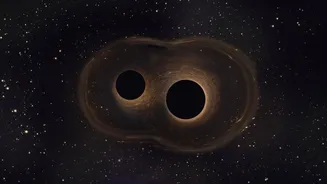
To understand the breakthrough, you first have to appreciate the mind-boggling scale of LIGO. The facility detects gravitational waves—ripples in the very fabric of spacetime—from cosmic events like colliding black holes. It does this by measuring a change
in the length of its 4-kilometer arms that is smaller than one ten-thousandth the width of a proton. To achieve this impossible precision, LIGO circulates laser beams with power approaching one megawatt between its mirrors. This incredible power sharpens its vision, but it also creates an ironic side effect: LIGO becomes a victim of its own success. The very tool it uses to see the universe creates distortions that can blind it.
The Problem of Self-Inflicted Noise
At the heart of LIGO are massive, 40-kilogram mirrors, among the most perfect optical components ever created. Yet, even they are not entirely flawless. As the megawatt-level laser bounces between them, the mirrors absorb a tiny fraction of that light energy as heat. This minuscule amount of heat is just enough to make the mirrors bulge by a few nanometers, a phenomenon known as thermal distortion. While a change measured in nanometers sounds insignificant, in an experiment measuring sub-atomic distances, it’s a critical source of noise that can mask the faint gravitational wave signals scientists are hunting for. For years, the challenge has been to counteract a problem that the instrument creates for itself.
A Camera to See the Heat
Researchers at the University of California, Riverside, have now pioneered a brilliant and surprisingly straightforward solution. Described in a recent paper in the journal Classical and Quantum Gravity, the new technique uses a high-resolution infrared thermal camera to take a detailed heat-map of the mirror’s surface in real time. Jonathan Richardson, who led the study, compares it to an engineer looking at a thermal image of a car engine to diagnose what's happening inside. By combining this thermal data with existing measurements and sophisticated computer models of heat flow, the team can create a complete, three-dimensional picture of the distortion across the entire mirror. This gives them an unprecedentedly accurate map of the problem they need to solve.
Applying the Perfect Correction
LIGO already has a Thermal Compensation System, which uses tools like targeted CO2 lasers to carefully apply heat to the mirrors and correct for distortions. However, this system was limited by an incomplete understanding of exactly how the mirror was misshapen at any given moment. It was like trying to fix a dent with only a vague idea of its shape and location. The new camera technique provides the exact blueprint of the distortion, allowing the compensation system to apply a perfectly opposing heating pattern. This effectively cancels out the thermal bulge, restoring the mirror to its ideal shape and eliminating a major source of noise from the detector's data. One of the most promising aspects of this innovation is that it relies on commercially available camera technology, making it a practical and relatively simple upgrade.
A Clearer View of the Cosmos
The implications of this breakthrough are profound. Researchers estimate this technique could boost the sensitivity of the next major upgrade, known as LIGO A+, by as much as 31 percent. A more sensitive detector can see farther into the cosmos, increasing the volume of the universe it can survey. This would allow LIGO to spot weaker or more distant events, such as the mergers of neutron stars an additional 33 million light-years away. For astronomers, this means moving from detecting a gravitational wave event perhaps once a week to potentially once every day. By quieting the noise from its own powerful lasers, LIGO is opening an even clearer window onto the universe’s most violent and mysterious events, promising a new flood of discoveries about the nature of space, time, and gravity itself.