


A New Look at a Celestial Classic
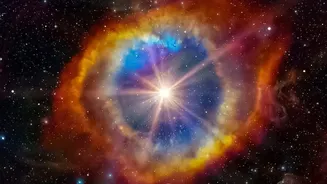
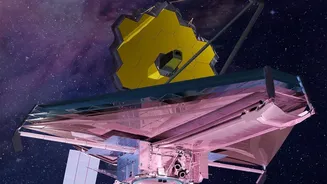
Astronomers have pointed the most powerful space telescope ever built at one of the most famous objects in the summer sky: the Ring Nebula. Known to astronomers as M57, this object is a classic example of a planetary nebula—the glowing, expanding shells
of gas shed by a dying star. Located about 2,500 light-years away in the constellation Lyra, the Ring Nebula has been a favorite target for telescopes big and small since its discovery in 1779. But never before has it been seen with the clarity and detail provided by Webb. Previous images showed a colorful, doughnut-like structure, but Webb's infrared vision has pierced through the glowing gas to reveal the intricate skeleton within.
Seeing the Unseen Structures
The new images from Webb's Near-Infrared Camera (NIRCam) and Mid-Infrared Instrument (MIRI) are astonishing. They show the main ring is composed of roughly 20,000 individual clumps of dense molecular gas, each about the mass of Earth. Inside the primary ring, a region previously thought to be mostly empty space is now shown to be filled with hot, filamentary gas structures. Perhaps most surprising are the features outside the main ring. Webb's MIRI instrument revealed about ten delicate, concentric arcs extending far out into the faint halo. These arcs suggest a much more complex history than previously assumed, hinting that the dying star was not alone.
An Astronomical Detective Story
So how did a perfectly spherical star create such a complicated, structured nebula? The presence of the outer arcs provides a major clue. Scientists theorize that these arcs were formed every 280 years or so as the central star was shedding its outer layers. This regular timing strongly suggests the dying star has a low-mass companion star in a wide orbit, similar to the distance between our Sun and Pluto. As this companion passed by, its gravity would have stirred up the material the central star was ejecting, creating the ripple-like arcs in the expanding gas, much like a boat creates a wake in water. Webb's ability to detect these faint structures is helping to solve a long-standing mystery about how these beautiful nebulae get their shapes.
The Chemistry of a Dying Star
Beyond its structure, Webb's observations provide an unprecedented look at the chemistry within the nebula. The telescope's instruments can detect specific chemical signatures. The main shell contains a thin ring rich in complex, carbon-based molecules known as polycyclic aromatic hydrocarbons (PAHs). These molecules are considered building blocks for life as we know it, and understanding how they form and survive in the harsh environment of a dying star is a key area of research. By seeing where these different elements and molecules are located, astronomers can build a more complete picture of the life cycle of stars and how they seed the galaxy with the raw materials for the next generation of stars and planets.