




The Challenge of Silent Giants
For decades, scientists have relied on seismometers to detect the subtle ground tremors that often precede a volcanic eruption. This works well for volcanoes on land, but a staggering 75% of the world's volcanic activity happens sight unseen, deep beneath
the ocean's surface. Monitoring these submarine giants is far more difficult. Conventional seismic waves lose energy and become faint over long distances in the Earth's crust, making it hard to get a clear picture of what's happening miles below the water. This monitoring gap poses a significant risk, as underwater eruptions can trigger devastating tsunamis with little to no warning, as the world witnessed with the 2022 Hunga Tonga-Hunga Ha'apai eruption.
A New Way of Listening
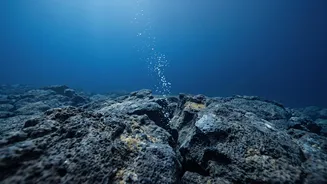
The breakthrough comes from a field known as hydroacoustics—the study of sound in water. Sound travels incredibly efficiently through seawater, much better than seismic waves travel through rock. Researchers have discovered that volcanoes produce a rich and varied soundtrack. These aren't just loud explosions; they include a whole range of acoustic signals. There are low-frequency hums and tremors caused by magma moving deep underground, impulsive 'popping' sounds from the rapid cooling of lava as it meets cold seawater, and powerful 'booms' from the collapse of a caldera. By placing underwater microphones, called hydrophones, scientists can eavesdrop on a volcano, building a library of its unique acoustic signature.
The Symphony of an Eruption
The key to an early warning system lies in identifying the pattern of these sounds. The 2022 Hunga eruption provided a wealth of data, showing that the most destructive tsunami was generated not by the initial blast, but by the collapse of the volcano's caldera about 90 minutes later—an event that produced a massive and distinct underwater sound signal. This sound wave travelled through the ocean at about 1.5 kilometres per second, more than seven times faster than the tsunami it created. This time difference is the crucial window for an early warning. Other research focuses on different acoustic clues. At Kīlauea in Hawaii, scientists are using the constant hum of ocean waves crashing on the shore. They measure how fast these vibrations travel through the volcano; as magma rises, it creates cracks that slow the vibrations down, providing a potential forecast days or even weeks in advance.
Relevance for India
This research holds particular significance for India, home to South Asia's only confirmed active volcano: Barren Island in the Andaman Sea. Located about 138 kilometres from Port Blair, Barren Island has erupted intermittently for centuries, with recent activity recorded as recently as 2025 and 2026. While the island is uninhabited, its eruptions can produce ash plumes that disrupt air travel and pose a potential, if remote, tsunami risk to the Andaman and Nicobar coastline. Currently, the volcano is monitored using satellite data and seismic stations. Integrating a hydroacoustic monitoring network in the Andaman Sea could provide a more detailed, real-time picture of the volcano's activity, offering an additional layer of safety for vital shipping lanes and coastal communities.
From Sound to Warning Signal
Despite its promise, the technology still faces hurdles. The ocean is a noisy place, filled with the sounds of shipping traffic, marine life, and waves. Scientists must develop sophisticated algorithms to filter out this background noise and isolate the specific acoustic signatures of volcanic activity. Furthermore, they need to establish a clear link between a particular sound and a specific volcanic process to ensure that warnings are reliable. Researchers are now deploying autonomous hydrophone floats and even using fibre-optic cables on the seafloor to create more comprehensive listening networks. These systems would need to automatically recognise a dangerous signal and trigger an alert, much like existing systems do for earthquake-generated tsunamis.