




A Tricolour in Orbit
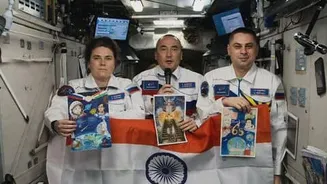
As India prepares to celebrate its 80th Independence Day, a unique tribute came from the final frontier. In a video message from the International Space Station (ISS), Roscosmos cosmonauts Pyotr Dubrov, Anna Kikina, and Andrey Fedyaev extended warm greetings
to the people of India. Holding the Indian tricolour aloft, the crew celebrated the long-standing cooperation between the two nations in space exploration. “Eight decades ago, India broke free from colonial rule and embarked on a journey towards self-reliance and prosperity,” said Pyotr Dubrov, acknowledging the historic milestone. Cosmonaut Andrey Fedyaev concluded the message with a simple, powerful declaration: “Long live India-Russia friendship!” The gesture was more than a simple greeting; it was a potent symbol of a relationship that has been instrumental in shaping India's journey into space.
A Friendship Forged in the Space Race
The roots of this partnership run deep, dating back to the early days of the space age. The Soviet Union played a pivotal role in the nascent stages of India’s space programme. In 1975, India's very first satellite, Aryabhata, was launched aboard a Soviet rocket. This was followed by the landmark flight of Rakesh Sharma in 1984, who became the first Indian in space aboard the Soviet Soyuz T-11 spacecraft. The cosmonauts on the ISS recalled the words of Yuri Gagarin, the first human in space, who visited India in 1961 and noted that while the country was beautiful from orbit, it was even more so on Earth, being home to “true friends.” This historical foundation, built on technology sharing and mutual respect during a period of intense geopolitical competition, created a bond that has outlasted the Cold War.
Powering India's Gaganyaan Ambition
Today, that historic collaboration has evolved to support India’s most ambitious space project yet: the Gaganyaan mission, which aims to send Indian astronauts into orbit on an Indian spacecraft. Russia has been a crucial partner in this national endeavour. The four astronaut-designates for the Gaganyaan mission—Group Captains Prashanth Nair, Ajit Krishnan, Angad Pratap, and Wing Commander Shubhanshu Shukla—underwent extensive training at Russia's famed Yuri Gagarin Cosmonaut Training Centre. This training covered critical aspects of human spaceflight, preparing the 'Gaganyatris' for the rigours of their mission. As cosmonaut Anna Kikina noted in her message from the ISS, the Gaganyaan programme represents a “new phase” in the India-Russia space relationship. Russia's assistance extends beyond astronaut training, with agreements in place for life support systems and other key technologies.
Looking Towards a Shared Future
The partnership continues to expand into new frontiers. As India plans to build its own space station, the Bharatiya Antariksh Station (BAS), by 2035, it once again looks to its long-standing ally. Indian and Russian space officials have held discussions about collaborating on this monumental project, with ISRO expressing a desire to partner with Russia, leveraging its vast experience in long-duration space missions. In a multipolar world with a rapidly commercialising space sector, the India-Russia axis remains a cornerstone of both nations' strategic ambitions. Regular high-level talks between ISRO and Roscosmos continue to explore cooperation on advanced launch systems, satellite navigation, and futuristic technologies. This ongoing dialogue ensures the relationship adapts to the challenges and opportunities of the 21st-century space landscape.