







A Heart That Leaks
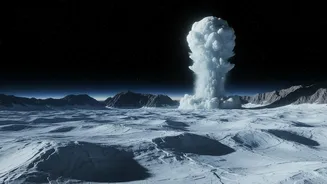
Pluto, a world so cold that its mountains are made of water ice and its plains are vast glaciers of frozen nitrogen, is proving to be anything but dormant. A recent study provides the first strong evidence that liquid nitrogen may be erupting from beneath
its surface and flowing across the iconic heart-shaped region known as Tombaugh Regio. Specifically, scientists focused on Sputnik Planitia, the western lobe of this 'heart,' a massive nitrogen glacier larger than Texas and Oklahoma combined. The findings, published in the Planetary Science Journal, challenge our long-held views of Pluto as a geologically dead world and suggest it is far more active than previously imagined. “Pluto never stops surprising us,” said Alan Stern, the principal investigator for the New Horizons mission.
Reading the Icy Clues
The evidence comes from a fresh analysis of high-resolution images captured during the New Horizons spacecraft's historic flyby in 2015. Researchers noticed dark, linear streaks and diffuse patches along the boundaries of large, city-sized convection cells on the surface of the Sputnik Planitia glacier. These patterns strongly resemble features seen on Earth's own ice sheets, such as in Greenland, where meltwater darkens the surface as it flows. Since Pluto's thin atmosphere and extreme cold make nitrogen rain a physical impossibility, the liquid must be coming from below. The study suggests that this is evidence of liquid nitrogen seeping up through cracks in the ice, temporarily 'wetting' the surface before freezing again.
The Science of a Cryo-Eruption
So how could liquid nitrogen exist on a world where surface temperatures hover around minus 235 degrees Celsius? The answer lies deep beneath the ice. Computer models developed by the research team show that the immense pressure under Sputnik Planitia's kilometres-deep nitrogen ice sheet could be enough to melt the nitrogen at its base. This liquid nitrogen, being less dense than the solid ice above it, would then be buoyant. Driven by this buoyancy or pressure from below, the liquid could be forced upward through fractures and conduits in the ice, similar to how magma rises through rock on Earth. Scientists theorise that this process would happen in relatively short, intense pulses, releasing large volumes of liquid over hours or days before it refreezes on the frigid surface.
A World of Ice Volcanoes
This phenomenon is a form of cryovolcanism—volcanoes that erupt icy, volatile substances instead of molten rock. Finding evidence for recent or even ongoing cryovolcanism fundamentally changes our understanding of Pluto. It implies that the dwarf planet has enough internal heat to maintain liquid deep underground, a surprising trait for such a small, distant body. This geological activity helps explain why the surface of Sputnik Planitia is so young, estimated to be less than 10 million years old, and almost entirely free of impact craters. The surface is constantly being renewed and repaved by these icy flows, erasing the scars of ancient impacts.