


A Cosmic Collision Course
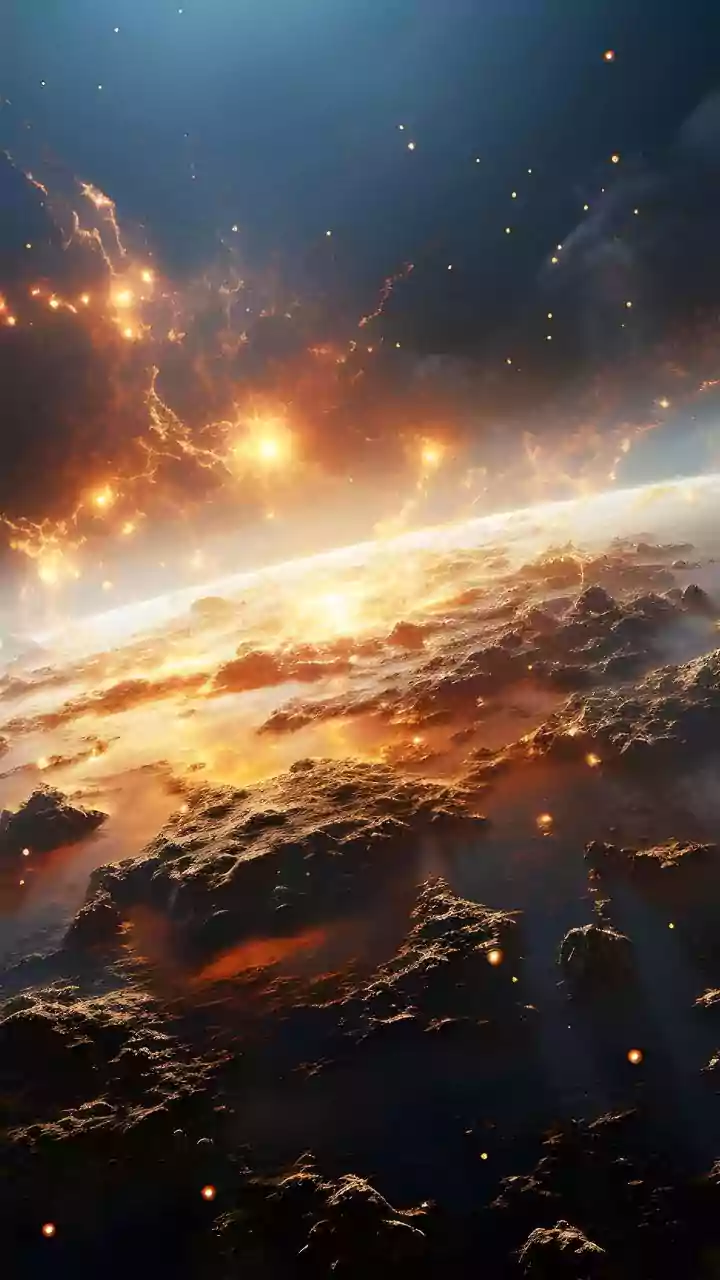
Galaxies, much like everything else in the universe, are not static. They are constantly moving, and sometimes, they collide. A galactic merger is one of the most violent events in the cosmos. When two galaxies draw close, their immense gravitational
forces begin to tear at each other. A "major merger" happens when the colliding galaxies are of a comparable size. These events are transformative, capable of destroying the elegant spiral discs of the original galaxies and forging a new, larger, and often more chaotic galaxy in their wake. These mergers can trigger massive bursts of star formation and fundamentally reshape the orbits of billions of stars. For a long time, astronomers believed that while mergers scrambled star paths, the overall orientation of the resulting galactic disc would remain relatively stable.
The Mystery of the Slow Halo
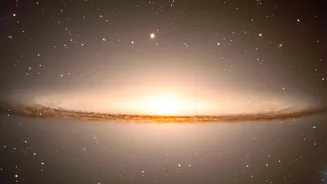
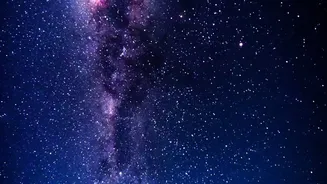
Every spiral galaxy, including our own, has two main visible components. There is the dense, flat galactic disc, where most of the stars, including our Sun, reside in orderly orbits. Then there is the stellar halo, a vast, sparse sphere of older stars that surrounds the entire disc. Data from the European Space Agency's Gaia mission revealed a long-standing puzzle: the Milky Way's stellar halo rotates very, very slowly. This was unexpected. Given the galaxy's mass and history, astronomers thought the halo should have more momentum. The slow spin suggested something dramatic had happened in our galaxy's past to put the brakes on.
Flipping the Galactic Script
To solve this mystery, researchers at Durham University turned to powerful supercomputer simulations. Using the Auriga suite of cosmological simulations, they modelled the evolution of 25 galaxies similar in size to the Milky Way over billions of years. The simulations showed a strong correlation: galaxies with the slowest-spinning stellar haloes had almost all experienced two key events. First, they underwent a major, head-on merger with another large galaxy. Second, the collision caused a dramatic 'disc flip', where the entire galactic disc reoriented itself, sometimes by more than 90 degrees. Essentially, the violent gravitational forces from the merger exerted a torque that gradually tipped the entire galaxy into a new orientation within its dark matter halo.
Rewriting the Milky Way's Story
This simulation result has profound implications for our own home. Astronomers already have strong evidence that the Milky Way experienced a massive, head-on collision around 10 to 11 billion years ago with a dwarf galaxy nicknamed Gaia-Sausage-Enceladus. This was the largest known merger in our galaxy's early history and is known to have reshaped it, leaving billions of stars in highly elongated orbits. The new simulations suggest this very collision could be the event that caused the Milky Way's disc to flip. This would not only explain the slow rotation of the stellar halo but also means that our galaxy's current orientation is not the one it has held for its entire life. Our solar system, and everything we see in the night sky, may once have been pointed in a completely different direction.
A Violent but Normal Past
The finding that a cataclysmic event could flip a galaxy over without completely destroying its disc is a major shift in our understanding. It shows that even after an incredibly violent merger, a galaxy can settle back into a surprisingly normal-looking spiral shape. This helps astronomers place the Milky Way in a broader context, suggesting that such flips might be a common, if dramatic, part of how large spiral galaxies evolve. This new chapter in our galaxy's story reminds us that the cosmos is a dynamic and turbulent place. The serene and stable galaxy we call home is the product of a violent past, with the evidence of its ancient collisions still written in the slow, silent dance of its halo stars.