







An Intriguing Coastal Succulent
Carpobrotus edulis, the plant commonly known as the African sour fig, is a hardy, creeping succulent native to South Africa. With its fleshy, triangular leaves and striking daisy-like yellow flowers that fade to pink, it's a common sight along coastal
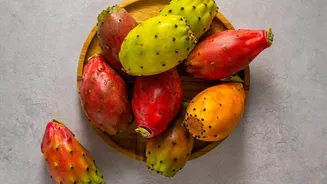
dunes and cliffs, where it forms dense mats. For centuries, it has been used as a soil stabilizer to prevent erosion, and its resilience has led to its introduction in coastal regions around the world, from the Mediterranean to California, where it is often considered an invasive species. The plant produces a fruit that is indeed fig-like in shape, which becomes wrinkled and leathery as it ripens. This fascinating plant is deeply embedded in South African culture, particularly that of the indigenous Khoisan people, who have utilized it for generations.
The Allure of Folk Medicine
The sour fig's reputation has long been tied to its extensive use in traditional medicine. The astringent juice from its leaves has been a go-to remedy for a wide range of ailments. Historically, it has been used as a gargle for sore throats and mouth infections, and applied topically to soothe burns, wounds, eczema, and insect bites. Some traditional practices also use it for digestive issues like diarrhea and constipation, and even for more serious conditions like tuberculosis and diabetes. While some modern scientific studies have noted that the plant contains compounds with antioxidant and antimicrobial properties, much of its medicinal use remains in the realm of folklore. Comprehensive clinical validation for many of these traditional claims is still lacking, leaving a gap between historical use and proven medical efficacy.
A Taste of the Coast
This is where the pivot from treatment to treat becomes compelling. The fruit of the sour fig, once ripe, offers a unique flavour profile that is at once sweet, sour, and slightly salty—a true taste of its coastal origins. The texture is a jelly-like pulp filled with tiny seeds, similar to a traditional fig. Traditionally, the fruit is eaten fresh—often by biting the end off and sucking out the contents—or made into a very tart jam or chutney. In the Cape region of South Africa, it's a well-known delicacy, sold at local markets and used to create products like 'Masala figs', a spiced sweet. Even the leaves are edible, though their strong, salty-sour crunch makes them more of an acquired taste, sometimes pickled or used sparingly in salads.
From Foraged Find to Fine Dining
The sour fig is experiencing a culinary renaissance, moving from a foraged seaside snack to an ingredient celebrated by innovative chefs. In South Africa, a new generation of culinary talent is championing indigenous ingredients, and the sour fig is finding its place on fine-dining menus. Chefs like Mmabatho Molefe and others are exploring the unique flavours of their heritage, using native plants to redefine modern South African cuisine. The sour fig's intense, complex flavour makes it a versatile ingredient. It can be transformed into jams, syrups for cocktails, chutneys to accompany savoury dishes, or even used as a unique flavouring for desserts. This renewed interest helps preserve cultural food knowledge and offers a more sustainable and exciting way to appreciate the plant, celebrating its verifiable qualities as a food source rather than its unproven medicinal benefits.