



The Challenge of Lunar Caves
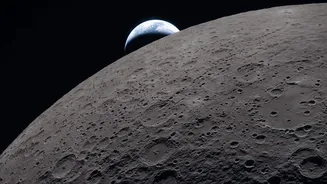
Beneath the Moon's heavily cratered surface lie geological treasures known as pits and lava tubes. These are natural caves and tunnels formed by ancient volcanic activity. Scientists and futurists are intensely interested in them for two main reasons.
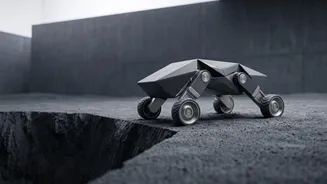
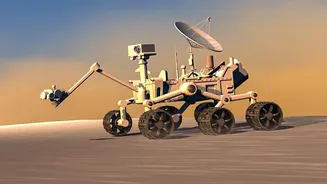
First, they are geological time capsules, with exposed rock layers that could reveal the Moon's history. Second, and perhaps more importantly, they are natural shelters. These subterranean networks could protect future human bases from the severe temperature swings, cosmic radiation, and micrometeoroid impacts that plague the lunar surface. The problem, however, is access. The entrances to these pits are often steep, rugged, and covered in loose, dusty soil called regolith, making them treacherous for conventional rovers. Small rovers are preferred for exploration missions because they are lighter and multiple can be sent to reduce risk, but their small wheels struggle to climb over rocks and up steep slopes.
Folding Paper into a Space Solution
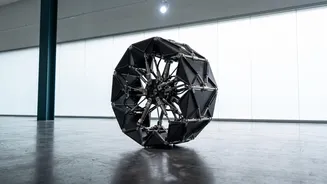
To solve this mobility problem, a joint research team from South Korea has turned to the ancient art of paper folding. Led by researchers at the Korea Advanced Institute of Science and Technology (KAIST), in collaboration with institutions like the Korea Aerospace Research Institute (KARI), they have developed a 'deployable airless wheel'. This isn't a rover in the traditional sense, but rather a revolutionary wheel system that can be fitted onto a small rover. Inspired by both origami and Leonardo da Vinci's self-supporting bridge designs, the wheel is made from flexible, high-carbon steel strips. It can transform its size without complex, jam-prone parts like hinges or motors. This design allows the wheel to expand from a compact 23 centimetres (about 9 inches) to a much larger 50 centimetres (about 20 inches) in diameter. A rover can thus travel to the Moon in a compact state, then expand its wheels on-site to gain the obstacle-climbing ability of a much larger vehicle.
Built to Survive the Moon
The lunar environment is one of the harshest imaginable. Any hardware sent there must withstand a vacuum, abrasive dust, and temperature fluctuations that can exceed 300 degrees Celsius between day and night. The Korean team has engineered the origami wheel with these challenges in mind. By using an elastic metal frame and fabric tensioners instead of traditional joints, the design is less vulnerable to lunar dust, which can clog and wear down mechanical parts. The airless design also means there are no tyres to puncture on sharp rocks. Rigorous testing has been a key part of the development. The team subjected the wheel to simulated lunar soil, confirming it has superior traction on loose slopes. In a particularly dramatic test, they confirmed the wheel could survive a drop equivalent to falling 100 meters in the Moon's lower gravity, proving its resilience to impacts during a rough landing or descent into a pit.
Powering South Korea's Space Ambitions
This innovative rover wheel is part of South Korea's broader and increasingly ambitious space program. Having successfully launched its own Nuri rocket and the Danuri lunar orbiter, the country is now aiming to land its first unmanned vehicle on the Moon by 2032. The development of key exploration technologies, such as rovers and their components, is a national priority involving a partnership between government, academia, and private companies like Unmanned Exploration Laboratory (UEL). While a specific mission for the origami rover has not yet been announced, Professor Dae-Young Lee of KAIST believes this technology positions the team as a leader in solving the critical problem of accessing lunar pits. By creating a novel way to reach these previously inaccessible sites, South Korea is not just contributing a piece of hardware; it is potentially unlocking the next frontier of lunar science and settlement.