






The Galactic Anchor
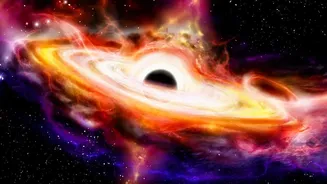
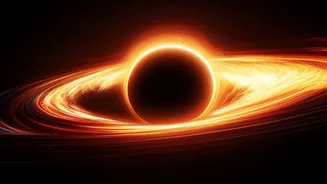
Almost every large galaxy, including our own Milky Way, is thought to have a supermassive black hole at its core. These cosmic behemoths, millions or even billions of times the mass of our Sun, act as gravitational anchors, holding their galaxies together.
Their immense gravity dictates the frantic dance of stars and gas clouds in the galactic center. Because they are so massive and centrally located, astronomers have long assumed this was the only place to find them. They are the predictable, stable heart of their sprawling stellar cities. When looking for the dramatic flare-ups caused by a black hole devouring a star, scientists have historically pointed their telescopes right at the galactic core.
A Telltale Flash in the Suburbs
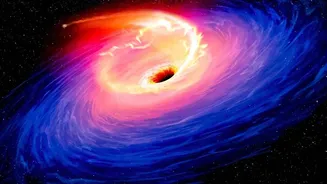
That’s what makes a recent discovery so electrifying. Astronomers using the Zwicky Transient Facility in California spotted an unusual flash of light in November 2025, not in the bustling center of a galaxy, but in its quiet suburbs. Follow-up observations, including with NASA's Neil Gehrels Swift Observatory, confirmed the flare was a 'tidal disruption event' (TDE). This is when a star wanders too close to a black hole and is shredded by its immense tidal forces, creating a brilliant, tell-tale glow. The flare, located in a galaxy 750 million light-years away, briefly outshone its entire host with the light of 10 billion suns. Most importantly, it was located more than 30,000 light-years from the galaxy's center—the furthest such event ever confirmed, proving a massive black hole was lurking where it shouldn't be.
Ghosts of Galaxies Past
So how does a million-solar-mass black hole end up so far from home? The leading theory points to a violent past. When galaxies collide and merge, a process that has shaped our universe for billions of years, their central supermassive black holes also begin to interact. In the ensuing gravitational tug-of-war between three or more black holes, the lightest one can be ejected, kicked out of the newly-formed galactic core and sent hurtling into the galactic halo. Another possibility is that a large galaxy, like the one observed, swallowed a smaller dwarf galaxy. The off-centre black hole could be the surviving core of that devoured galaxy, now left to wander through its conqueror's domain.
The Wandering Black Hole's 'Smoking Gun'
Because black holes themselves are invisible, these 'wandering' or 'rogue' black holes have been purely theoretical until now. They produce no light and are nearly impossible to detect unless they interact with something. A TDE is that interaction—a cosmic flare that acts like a signpost, screaming “a black hole is here!” Discovering a TDE so far out in a galactic halo is the 'smoking gun' evidence that scientists have been looking for. It validates the theory that galactic mergers can create a population of wandering black holes. This single discovery has confirmed a new technique for finding these hidden giants, using TDEs as a cosmic searchlight. Researchers, using AI algorithms to sift through massive amounts of data, can now actively hunt for these flashes in the galactic outskirts, which were previously ignored.