




Neither Fire Nor a Rainbow
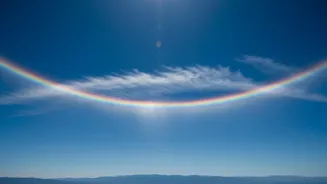
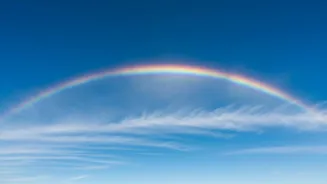
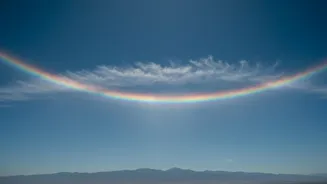
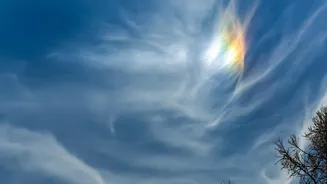
Despite its evocative name, the phenomenon has nothing to do with fire, and it isn't a rainbow in the traditional sense. Scientists call it a circumhorizontal arc. It's part of a larger family of atmospheric optical illusions known as ice halos, which
are formed by the interaction of light with ice crystals suspended in the atmosphere. Unlike a true rainbow, which is created by the refraction and reflection of light in liquid water droplets, a circumhorizontal arc owes its existence entirely to ice. The name “fire rainbow” likely comes from its vibrant, flame-like colours and the wispy, fire-like shape of the cirrus clouds where it appears.
A Precise Atmospheric Recipe
For a fire rainbow to appear, a very specific set of ingredients must come together perfectly. First, you need high-altitude cirrus clouds, which are thin, wispy clouds floating more than 6,000 metres above the ground where temperatures are low enough to form ice. Second, these clouds must contain plate-shaped, hexagonal ice crystals. Third, and most critically, these tiny, flat crystals must be oriented horizontally, like millions of microscopic plates floating parallel to the ground. If the crystals are randomly oriented, the effect is lost. This precise alignment is one reason the phenomenon is so rare.
The Critical Angle of the Sun
The final ingredient is the sun's position in the sky. A circumhorizontal arc will only form when the sun is at a very high elevation—specifically, more than 58 degrees above the horizon. This high angle allows sunlight to enter the vertical side face of the hexagonal ice crystals and exit through the bottom face. As the light passes through, it is refracted, or bent, just like light passing through a prism. This bending action splits the white sunlight into its component colours, creating the vibrant spectrum seen in the arc. The maximum intensity and brightness occur when the sun is around 68 degrees high.
A Rare and Fleeting Sight
The strict requirement for the sun to be higher than 58 degrees means that these arcs can't be seen everywhere on Earth. In locations north of 55°N latitude or south of 55°S latitude, the sun never gets high enough in the sky for a circumhorizontal arc to form. For mid-latitude locations, the best chance to spot one is during the summer months around midday, when the sun is at its highest point. Even with the right conditions, the clouds themselves must be in the right position in the sky relative to the observer. The arc always appears parallel to the horizon and far below the sun. Often, they can be fragmented or patchy if the cirrus clouds are not uniform.