






A Tool for a New Task
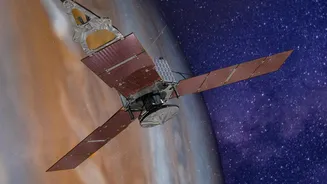
NASA's Juno probe arrived at Jupiter in 2016 with a primary mission: to understand the gas giant itself. One of its key instruments is the Microwave Radiometer (MWR), designed to peer deep beneath Jupiter’s swirling clouds to measure its atmospheric composition.
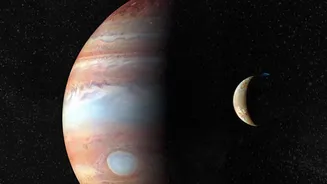
However, during an extended mission, scientists turned this powerful instrument towards Jupiter's moons, including the fiery satellite Io. This decision proved revolutionary. While past missions relied on infrared tools that could only read the temperature of Io's topmost surface, the MWR was able to do something entirely new: measure the heat radiating from beneath the moon's rocky crust for the very first time.
Peering Beneath the Crust
Think of the MWR as a sophisticated ear, listening for thermal energy at different microwave frequencies. Just as different radio stations broadcast on different frequencies, the heat from various depths beneath Io’s surface radiates at distinct microwave wavelengths. By capturing these signals during two close flybys in late 2023 and early 2024, Juno was able to construct a temperature map of Io's subsurface down to several meters. The data sent back was stunning. Everywhere the instrument looked, it found a steep temperature increase just a short distance below the ground—a rise of more than 20 degrees Celsius. This thermal gradient is far too significant to be caused by sunlight alone, confirming that immense heat is constantly flowing from the moon's tormented interior.
A Smoother, Fluffier Io
The microwave vision also upended some long-held assumptions about Io’s terrain. Visually, the moon is a landscape of extremes, with towering mountains and vast lava flows. Yet, to the MWR, large portions of the surface appear remarkably smooth over stretches of 100 kilometres or more. Scott Bolton, Juno's principal investigator, noted this suggested a surface more like the Great Plains of North America than a jagged volcanic wasteland. Furthermore, the data indicates that the crust itself is not dense, solid rock. Instead, it seems to be made of a surprisingly lightweight and porous material, much like pumice stone or fluffy volcanic ash. This suggests a world constantly being resurfaced by eruptions that leave behind a layer of less-compacted debris.
The Future of Volcanic Exploration
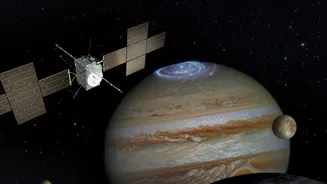
This new technique is more than just an interesting discovery about a distant moon; it represents a paradigm shift in planetary science. Understanding how heat moves through a planet's crust is fundamental to understanding its geology, and Juno's findings on Io provide a direct window into this process. Scientists believe this method could one day be applied to volcanoes here on Earth. An MWR-type instrument could potentially detect subsurface temperature changes that signal volcanic activity, offering a new tool for monitoring and forecasting eruptions. Beyond Earth, this microwave approach has already been used to probe the icy shells of Jupiter's other moons, Europa and Ganymede. By understanding how heat moves through their crusts, we can better assess the potential for liquid water oceans and, by extension, the possibility of life.