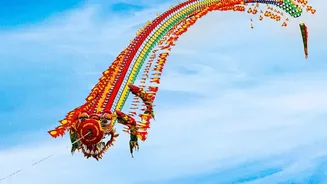








The Discipline of Waiting
The first lesson a kite teaches is that of the patient wait. You can have the finest kite and the sharpest manjha, but without the right wind, you remain grounded. This is a profound exercise in patience. You learn to read the subtle signs of nature,
to feel the shift in the breeze, and to know when to launch and when to hold back. Forcing a kite into a weak or turbulent wind only leads to frustration and a tangled mess. This teaches us that in life, as in kite flying, timing is crucial. Rushing into a project or a conversation without the right conditions can lead to failure. Patience isn't passive waiting; it’s active observation and readiness.
A Masterclass in Concentration
Once airborne, the kite demands your complete attention. This is not a passive activity. Your mind, eyes, and hands must work in perfect sync. You feel the slightest tug on the line, a signal of a change in wind velocity or direction. You are constantly making micro-adjustments, giving slack or pulling in, to keep the kite stable and soaring. This is mindfulness in action. For that period, the noise of the world fades, replaced by an intense focus on a single, joyful task. This state of deep immersion, often called a 'flow state', is where your skills are sharpest and you feel completely engaged. It's a mental workout that sharpens your ability to concentrate amidst chaos.
The Art of Balance and Control
Flying a kite is a delicate dance between control and surrender. Pull the string too hard, and you risk snapping the line or sending the kite into a nosedive. Give it too much slack, and you lose control, the kite drifting aimlessly until it falls. This is a powerful metaphor for navigating relationships and ambitions. True mastery lies in finding the balance, guiding with a gentle but firm hand. It teaches that exerting too much force is counterproductive. You learn to work with the forces of nature—or life—rather than fighting against them. This subtle control builds a sense of intuition and responsiveness.
Embracing the Battle and the Loss
In India, kite flying is often a competitive sport, a 'pench larana' or kite fight. This adds another layer of focus. You are not just managing your own kite but also anticipating the moves of your rivals. The objective is to expertly cross your manjha over your opponent's and, with a series of sharp tugs, sever their line. The triumphant shout of 'kai po che!' is exhilarating. But every victory for one is a loss for another. Watching your own kite get cut and drift away teaches a different kind of patience: the grace of acceptance. Not every ending is a failure. It's a lesson in letting go, in acknowledging that some things are beyond your control, and in having the resilience to simply pick up another kite and fly again.