







The Automation of 'Grunt Work'
For decades, the first rung on the corporate ladder involved a significant amount of repetitive work. Think data entry, drafting basic reports, summarizing research, and reviewing documents. These tasks were foundational, teaching newcomers the basics
of a business while providing necessary operational support. Now, generative AI tools can perform many of these functions faster and more cheaply. This doesn't mean entry-level jobs are disappearing entirely, but their core function is evolving. The economic calculation for companies has changed; routine task execution is no longer the primary reason to hire junior talent. Instead, the focus is shifting away from manual execution and towards judgment-based work.
A New Bar for Junior Talent
With AI handling the repetitive chores, companies now expect entry-level hires to contribute at a higher level from day one. The new baseline is not just familiarity with technology, but the ability to work alongside it. Employers are increasingly looking for candidates who can use AI tools to streamline workflows and then apply uniquely human skills to the output. These include critical thinking, creative problem-solving, communication, and interpreting AI-generated data with nuance and business judgment. AI literacy—knowing how to use tools like ChatGPT or Gemini—is becoming as standard as knowing Microsoft Excel. The real differentiator is the ability to manage, audit, and creatively apply what the AI produces, transforming a first draft into a final, polished product.
From Desk Farms to Decision Hubs
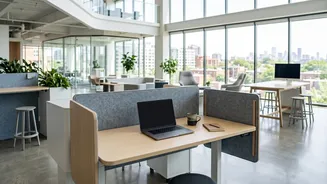
This fundamental shift in work directly impacts what employees need from their physical environment. If junior staff are no longer chained to desks for eight hours of data entry, the traditional office layout of cubicle farms becomes obsolete. The role of the office is transforming from a 'container for work' into a 'decision hub'. Research shows that employees who are power users of AI tend to spend more time collaborating, learning, and socializing at the office. This creates a demand for a different kind of space: fewer individual workstations and more flexible, collaborative environments. Think more small meeting rooms, breakout spaces with smartboards for interactive brainstorming, and acoustically private booths for focused work or voice-prompting AI tools.
Infrastructure for a Hybrid Human-AI Workforce
The office of the future requires both a physical and digital overhaul. Digitally, reliable, high-speed connectivity is no longer a convenience but a prerequisite. The infrastructure must support advanced videoconferencing for hybrid meetings and widespread use of data-intensive AI platforms. Physically, spaces must be adaptable. AI-powered building management systems can optimize lighting, temperature, and even room layouts based on real-time usage data, making the workspace more efficient and responsive. Furniture itself may become 'intelligent', adapting to ergonomic needs. The goal is to create a people-focused environment that supports the skills AI cannot replicate: creativity, strategic thinking, and human connection.
The Indian Context: A Strategic Imperative
For India, with its enormous demographic dividend of young workers, this transition is particularly critical. Companies that continue to rely on a model where junior employees perform automatable tasks risk falling behind. The challenge is to redesign entry-level roles and the offices that house them to foster the next generation of innovators and leaders. This means investing in infrastructure that supports continuous learning and collaboration. The firms that successfully make this transition will not only boost productivity but also attract top talent by offering roles focused on higher-value, more engaging work from the very beginning of a career. It's an investment in future-proofing both the workforce and the business itself.