



The Universe's 'Failed Stars'
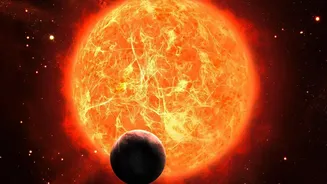
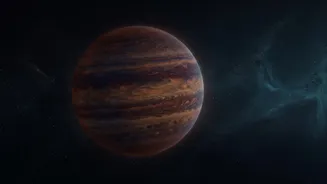
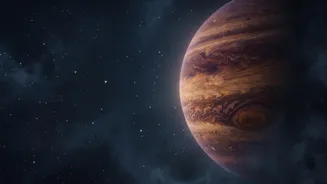
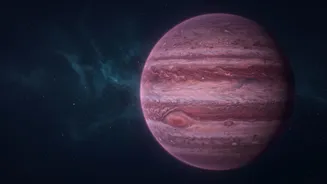
Imagine an object more massive than Jupiter, but not quite massive enough to become a star. That's a brown dwarf. They are born from the collapse of gas and dust clouds, just like stars, but they lack the immense gravitational pressure needed to ignite
sustained hydrogen fusion in their cores—the engine that powers stars like our Sun. Instead, they can only briefly fuse a heavier form of hydrogen, called deuterium, before they begin to cool down, slowly fading over billions of years. This places them in a unique category between the largest gas giants and the smallest stars, with masses typically ranging from 13 to 80 times that of Jupiter. Because they don't produce their own light through fusion, they are incredibly faint and radiate most of their energy as infrared heat, making them challenging to detect.
A Perfect Planetary Laboratory
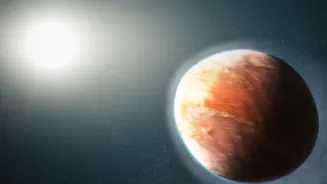
Studying the atmospheres of exoplanets—planets orbiting other stars—is incredibly difficult. Their light is usually completely overwhelmed by the glare of their parent star. This is where brown dwarfs become exceptionally useful. Many brown dwarfs drift through space alone, untethered to a star. This isolation allows telescopes, like the powerful James Webb Space Telescope (JWST), to observe them directly and analyze their atmospheric chemistry in great detail. Because brown dwarfs cool down over time, their temperatures can be very similar to those of giant gas exoplanets. This makes them excellent natural laboratories for understanding the physics and chemistry that occur in the atmospheres of super-Jupiters without a star's blinding light getting in the way.
Reading the Chemical Fingerprints
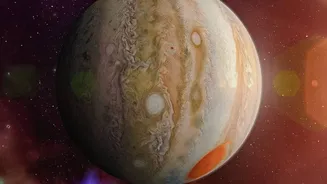
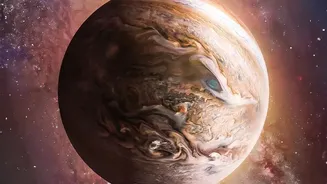
When scientists analyze the light from a brown dwarf, they can see the chemical fingerprints of the molecules in its atmosphere. Thanks to sensitive instruments, astronomers have detected the presence of water, methane, carbon monoxide, and carbon dioxide. The atmospheres of these objects are dynamic, with some even having clouds made of hot sand grains (silicates), aluminum oxide, or sodium iodide. Recent observations with the JWST have pushed the boundaries of discovery, identifying brown dwarfs as small as just two or three times the mass of Jupiter. In the atmospheres of these very cool, low-mass objects, researchers have even detected an unidentified hydrocarbon molecule, suggesting a unique chemistry that might set these smallest brown dwarfs apart.
From Brown Dwarfs to New Worlds
The knowledge gained from studying the diverse chemistry of brown dwarfs provides a crucial foundation for interpreting observations of actual exoplanets. By creating detailed models of brown dwarf atmospheres, scientists can better understand the atmospheric processes on gas giants orbiting other stars. For example, understanding the cloud composition and temperature layers in a brown dwarf helps astronomers recognize similar features in the limited data they can gather from a distant exoplanet. It bridges a critical gap, allowing scientists to test theories of atmospheric physics and planet formation. Ultimately, comparing the chemical makeup of brown dwarfs to that of giant planets also provides clues about how these different objects form—whether through the gravitational collapse of a gas cloud like a star, or through accretion in a disk around a star like a planet.