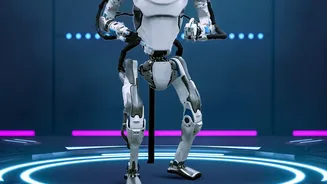








Musk's Startling Timeline
The prediction that AI could become smarter than the entire human race by 2029 was made by Elon Musk on his social media platform, X. His forecast was a response to famed inventor and futurist Ray Kurzweil, who had projected that AI would match any single
person by 2029. Musk accelerated that timeline, suggesting AI would surpass a single human's intelligence much sooner and achieve collective superiority by the same year. This isn't just a casual observation; it's a reflection of the rapid advancements Musk is pursuing with his own company, xAI, which is developing a series of increasingly powerful models named Grok. For years, Musk has been vocal about the potential dangers of advanced AI, even calling for regulation and warning of its potential for "civilizational destruction" if mismanaged.
What is Artificial General Intelligence?
At the heart of this debate is the concept of Artificial General Intelligence, or AGI. Unlike the AI we use today, which is designed for specific tasks like writing text or recognizing faces, AGI refers to a machine with the ability to understand, learn, and apply its intelligence to solve any problem a human being can. The ultimate goal for some researchers is Artificial Superintelligence (ASI), where an AI becomes vastly smarter than the most gifted human minds in virtually every field. Musk's prediction implies a rapid transition from today's narrow AI directly to a form of superintelligence. The definition of AGI itself is a moving target; some define it as being able to automate complex jobs, while others see it as capable of novel scientific discovery. This lack of a clear, agreed-upon definition makes forecasting its arrival incredibly difficult.
The Skeptics Fire Back
Not everyone in the AI field shares Musk's aggressive timeline. Yann LeCun, Meta's chief AI scientist and one of the 'godfathers of AI,' is a prominent skeptic. He has bluntly dismissed such short-term predictions, arguing that current AI models, known as Large Language Models (LLMs), are missing a key ingredient for true intelligence. LeCun points out that even with massive amounts of training data, we still don't have truly reliable self-driving cars—a task a 17-year-old can learn in 20 hours. He has even stated that today's most advanced AIs are not as smart as a common house cat in terms of understanding the physical world and planning complex actions. Other experts and academics believe AGI is still decades away, emphasizing that simply scaling up current technology won't be enough to bridge the gap to human-level reasoning.
An Accelerating Arms Race
Regardless of the exact timeline, one thing is certain: the race to build more powerful AI is accelerating at an unprecedented rate. Companies like OpenAI, Google DeepMind, Anthropic, and Musk's own xAI are locked in a fierce competition, pouring billions into building ever-larger and more capable models. This competitive pressure drives progress forward, shortening development cycles and leading to breakthroughs that seemed like science fiction just a few years ago. The sheer scale of investment in computing power, with some companies building data centers containing hundreds of thousands of advanced GPUs, signals a belief within the industry that major leaps are on the horizon. This frenetic pace is a key reason why timelines that once spanned decades are now being discussed in terms of single-digit years.
So, Should You Be Worried?
Musk's prediction taps into a deep-seated anxiety about a future where humanity is no longer the most intelligent force on the planet. The implications are profound, touching on everything from economic stability and job displacement to existential risks. Proponents envision a utopian future of unimaginable prosperity, where AI solves humanity's greatest challenges. On the other hand, figures like Musk and the late Geoffrey Hinton have warned of catastrophic outcomes if such powerful technology is not developed with extreme caution. The core challenge is the 'alignment problem': ensuring that an AI's goals are aligned with human values. As these systems become more autonomous, the concern is that their actions could have unintended and irreversible consequences. This has spurred a global conversation about the urgent need for ethical guidelines and governance to manage AI's development responsibly.