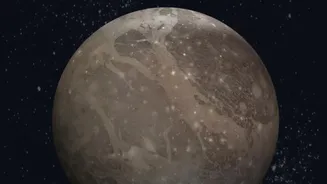








A Heart of Ice and Mystery
Ever since NASA’s New Horizons spacecraft flew past Pluto in 2015, scientists have been captivated by its surprisingly complex and active surface. The most iconic feature is a massive, heart-shaped basin of nitrogen ice called Tombaugh Regio. The western
lobe of this heart, known as Sputnik Planitia, is a vast glacier larger than Texas and Oklahoma combined. Images revealed this region is not a static, frozen wasteland but a dynamic surface covered in city-sized cells of churning ice that are constantly renewing themselves through convection. Along the edges of these cells, scientists spotted puzzling dark lines and patches, and for years, their origin remained a subject of debate.
An Unexpected Liquid Source
A new study published in The Planetary Science Journal offers a compelling explanation for these dark features. Researchers propose that liquid nitrogen may be seeping up from deep beneath Pluto's icy crust. Because Pluto’s atmosphere is so thin and cold, nitrogen rain is impossible, meaning any liquid must come from below. Using computer models, scientists showed that the immense pressure at the base of Sputnik Planitia's nitrogen glacier, which is several kilometers deep, could be enough to melt the nitrogen ice. This liquid nitrogen, being less dense than the solid ice above it, would then be forced upward through cracks and fissures in the glacier.
How the Dark Patches Form
According to the theory, when this subterranean liquid nitrogen reaches the surface, it temporarily 'wets' the frozen nitrogen ice, much like meltwater darkens snow and ice on Earth's glaciers. The research team even compared the New Horizons images to satellite photos of Greenland's ice sheet, finding similar dark patterns where liquid water had emerged. On Pluto, this liquid nitrogen would quickly refreeze, but not before leaving behind the distinctive dark stains observed by the spacecraft. This process would create the narrow lines and broader, diffuse patches seen along the boundaries of the convective ice cells on Sputnik Planitia.
What About Other Reddish Features?
It is important to note that these dark patches are different from other colorful regions on Pluto. For years, scientists have attributed Pluto's more widespread reddish hues to complex organic molecules called tholins. These reddish compounds are thought to form when ultraviolet light from the sun or cosmic rays interact with methane in Pluto's thin atmosphere and on its surface, creating a kind of reddish 'gunk' that settles on the ground. The new theory specifically addresses the dark, linear features in the Sputnik Planitia region, suggesting a more localized, geological process rather than an atmospheric one.
A More Dynamic Dwarf Planet
This discovery fundamentally changes our understanding of Pluto. Instead of a static, geologically dead world, the evidence points to a planet with active subsurface processes, akin to a form of plumbing. The idea that liquid can exist and flow, even 'recently' in geological terms (within the last million years), suggests Pluto is much more dynamic than previously imagined. Alan Stern, the principal investigator of the New Horizons mission, stated that these findings indicate a new kind of time-variable feature on the dwarf planet. This suggests that Pluto may be actively resupplying nitrogen to its surface from its interior, possibly through processes like cryovolcanism.