



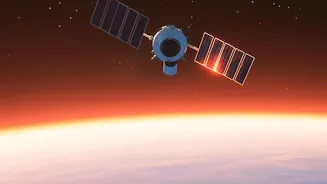
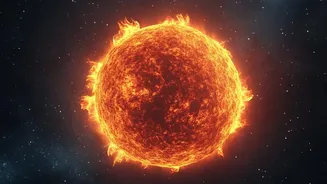
India’s eye on the Sun, the Aditya-L1 observatory, has made a groundbreaking discovery that changes how we see solar eruptions. It found a massive ejection of solar material was not a uniform bubble, but a tilted, lopsided cloud.
A New Look at Solar Storms
Our Sun is an active,
volatile star, frequently releasing enormous bursts of plasma and magnetic fields known as Coronal Mass Ejections (CMEs). For decades, scientists have largely modelled these events as symmetrical bubbles expanding uniformly outwards. However, new research from India's Aditya-L1 mission challenges this long-held assumption. Scientists at the Indian Institute of Astrophysics (IIA) in Bengaluru analysed data from a CME that occurred on August 5, 2024. Their findings, published in The Astrophysical Journal Letters, revealed that the eruption expanded asymmetrically and had a distinct tilt, a discovery with significant implications for our understanding of space weather.
The Tools That Made It Possible
This detailed observation was made possible by the primary instrument aboard Aditya-L1, the Visible Emission Line Coronagraph (VELC). Unlike conventional coronagraphs that only capture a two-dimensional image of a CME moving across the sky, VELC is a spectrograph. It can measure the velocity of the plasma along the observer's line of sight. It does this by analysing the Doppler shift—the same principle that makes an ambulance siren sound higher as it approaches and lower as it moves away. By detecting shifts in the wavelength of light emitted by superheated iron particles in the corona, VELC can tell whether plasma is moving towards or away from the spacecraft. For the August 5th event, it detected plasma moving in both directions simultaneously, a clear sign of a complex, three-dimensional structure that wasn't a simple, expanding sphere.
Challenging the 'Perfect Bubble' Model
To interpret VELC's unusual data, the IIA team developed a three-dimensional model of the eruption. They discovered that a model assuming a symmetrical, uniformly expanding bubble could not replicate the spectral patterns VELC had recorded. However, when they introduced a tilt to the eruption's axis and allowed for uneven, or asymmetric, lateral expansion, the model was an excellent match for the real-world observations. This confirms that CMEs can be much more complex in their early stages than previously thought. The lateral expansion, or sideways growth, appears to be a crucial and non-uniform part of their development.
Why an Uneven Eruption Matters for Earth
This discovery is more than just an academic curiosity; it has direct consequences for protecting our technology‐dependent society. CMEs are the primary drivers of severe space weather events. When a CME slams into Earth's magnetic field, it can induce powerful geomagnetic storms that disrupt satellite operations, cripple communication networks, damage power grids, and pose a radiation hazard to astronauts. Predicting the arrival time and impact of these storms is crucial. The shape and expansion of a CME influences how it interacts with the solar wind—the constant stream of particles from the Sun. An asymmetric CME might experience different levels of drag, altering its speed and trajectory in ways that simpler models cannot predict. A better understanding of how CMEs truly evolve from the moment of eruption will lead to more accurate space weather forecasts, giving us more reliable warnings for potentially disruptive solar events.