


A Star's Secret Appetite
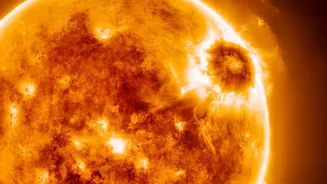
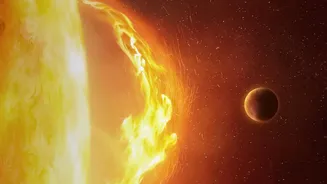
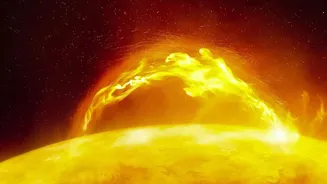
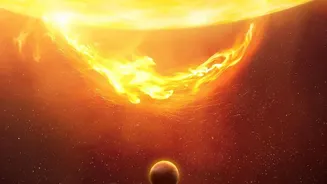
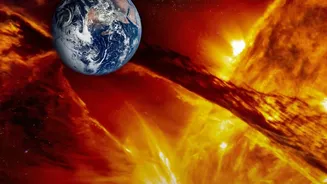
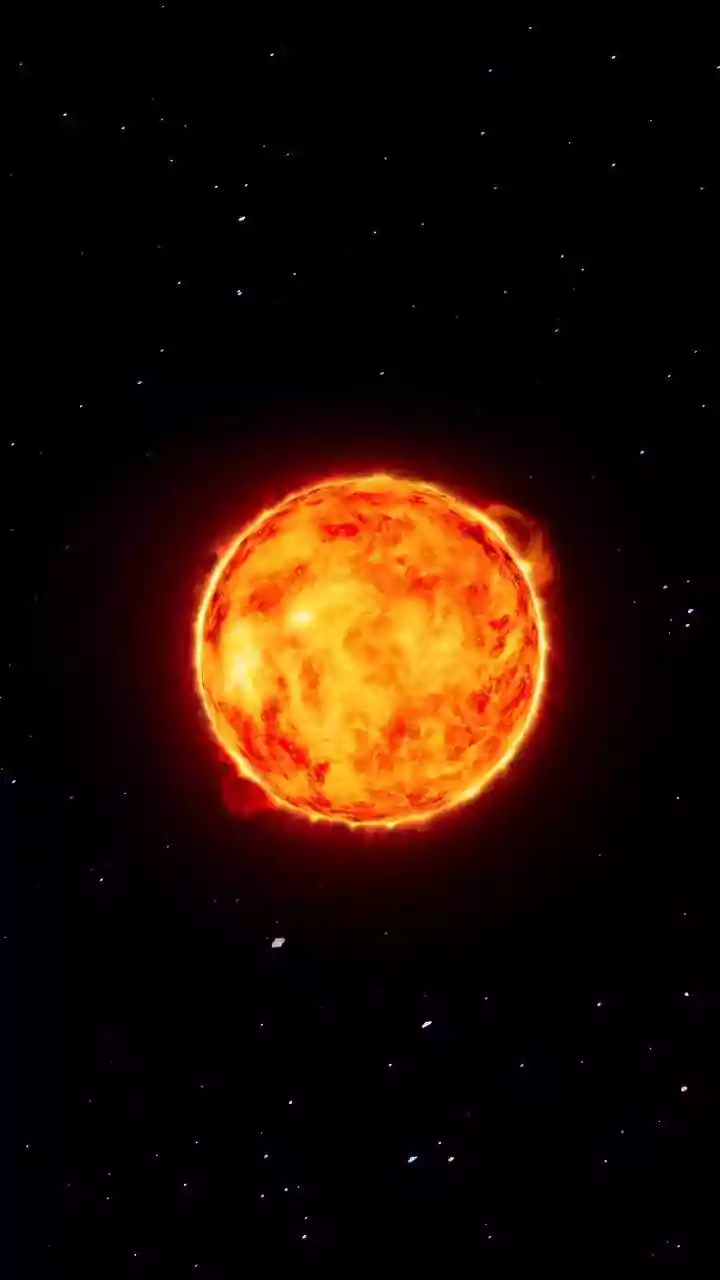
The story of our solar system is one of cosmic creation, but it may also involve destruction. A recent study proposes a dramatic event from our Sun's youth: that it consumed a 'super-Earth,' a planet several times more massive than our own, billions of years
ago. This isn't just a random theory; it's an attempt to solve several long-standing puzzles about our star that standard models of stellar evolution can't quite explain. For example, the Sun has surprisingly low levels of the element lithium on its surface, and there are subtle mismatches between the predicted and observed speed of sound waves traveling through its interior. An event as significant as consuming a planet could, in theory, leave a lasting imprint that accounts for these anomalies. The idea also helps explain a curious absence in our own cosmic neighbourhood. While super-Earths are common in other star systems, we don't have any in our own. Perhaps one existed long ago, only to get too close and become a meal for the young, growing Sun.
The Chemical Clues Left Behind
If a star swallows a planet, it doesn't just disappear without a trace. The planet's material dissolves into the star's outer layers, changing its chemical makeup. Scientists theorise that by engulfing a rocky planet, a star's atmosphere would become enriched with heavier elements. These chemical fingerprints are what astronomers hunt for. The new research, led by Professor Mutlu Yildiz of Ege University in Turkey, used computer models to simulate this very scenario. By modelling the Sun's evolution, the team found that the ingestion of a super-Earth between five and ten times Earth's mass could neatly explain the Sun's current characteristics, including its depleted lithium. The models suggest that a planet of this size would be dense enough to plunge through the Sun's turbulent outer layers and deliver its material deeper into the interior, leaving a more permanent signature than a smaller body might.
The All-Important Qualification
This is where the headline's 'key qualification' comes in. While the planet-engulfment hypothesis is a compelling explanation, it is not yet proven fact. The research is based on sophisticated computer modelling, not direct observation. As the study's authors are careful to note, other explanations for the Sun's quirks remain possible. Think of it as elegant detective work based on circumstantial evidence. The model shows that a planet-swallowing event fits the 'crime scene'—the Sun's current state—but it doesn't provide a direct photo of the event happening. The one-dimensional models used in the study also cannot fully capture the complex, multi-dimensional physics of a planet actually plunging into a star. Proving the theory requires finding independent, physical evidence of these predicted structural and chemical signatures deep within the Sun.
Why This Cosmic Detective Work Matters
So what's next? Scientists can now hunt for that definitive proof. Using a technique called helioseismology, which studies sound waves that ripple through the Sun's interior, researchers hope to one day map its structure and composition in enough detail to spot the lingering evidence of an ancient planetary meal. Confirming this theory would be a major breakthrough. It would not only solve several mysteries about our own Sun but also provide concrete evidence that stars can preserve the history of planets they destroy. The idea that planetary systems have violent and dynamic histories is gaining traction, with studies suggesting a significant fraction of Sun-like stars show signs of having ingested planetary material at some point. Each star with these chemical quirks is a clue, telling us that the formation and evolution of planetary systems isn't always a calm and orderly process. Uncovering the Sun's past could therefore give us a profound new window into the life and death of planets across the galaxy.