



The Universe's Missing Mass
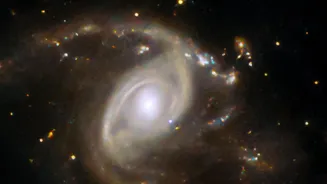
Imagine looking at a city at night. You see the lights from buildings and cars, but you know the city is much more than that—roads, foundations, pipes, and people you can't see. The universe is similar. For nearly a century, astronomers have noticed that galaxies
spin so fast they should fly apart. The gravity from all the visible stars, gas, and dust isn't nearly enough to hold them together. To account for this, scientists proposed the existence of an invisible substance called 'dark matter'. This mysterious stuff doesn't emit, absorb, or reflect any light, making it completely invisible to our telescopes. Yet, based on its gravitational effects, we know it's out there, forming a kind of invisible scaffolding for the cosmos. Scientists estimate that all the 'normal' matter we see accounts for only about 15% of the total matter in the universe; the rest is dark matter.
An Elegant Idea: Primordial Black Holes
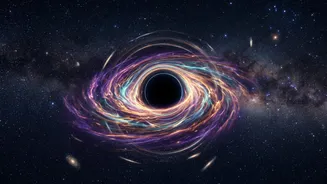
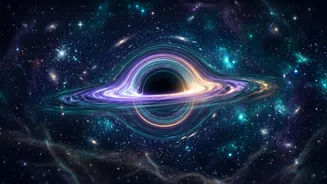
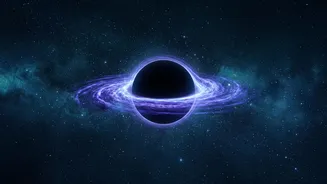
So, if dark matter is real, what is it made of? One of the most intriguing possibilities involves primordial black holes (PBHs). Unlike the black holes that form from collapsing giant stars, PBHs are thought to have formed in the chaotic, dense environment of the very early universe, just moments after the Big Bang. This theory was appealing because it didn't require inventing new, exotic particles. Black holes are a known part of our universe, and if enough of them were created in a wide range of sizes back then, they could collectively provide the missing mass we observe today. These ancient black holes, ranging from the mass of an asteroid to thousands of times the mass of our Sun, would drift silently through space, their combined gravity shaping the galaxies around them without giving off any light.
What the New Report Found
The latest research has put a serious dent in the PBH theory. A recent study, likely leveraging powerful telescopes like the Subaru Hyper Suprime-Cam, searched for evidence of these black holes. While we can't see black holes directly, we can spot them by their gravitational effects on the light behind them. This effect is known as gravitational lensing. If PBHs made up a significant portion of dark matter, scientists would expect to see a specific number of these lensing events as the black holes pass in front of distant stars. However, the recent observations found far fewer of these events than the theory predicted. The conclusion is that while primordial black holes might exist, they are not numerous enough to account for the vast majority of dark matter. They can, at best, be a very small part of the solution.
How Science Rules Out a Theory
The technique used to test this theory, gravitational lensing, works like a cosmic magnifying glass. According to Einstein's theory of general relativity, massive objects warp the fabric of spacetime around them. When light from a distant star travels past a massive object like a black hole, its path is bent. To us on Earth, this can make the background star appear to briefly brighten or its position seem to shift. By monitoring millions of stars for these tell-tale flickers, astronomers can count the invisible massive objects passing by. The recent studies did just that, scanning vast patches of the sky, particularly in the direction of the nearby Andromeda galaxy, for these lensing signals. The rarity of these signals provided the strong evidence needed to constrain the number of PBHs, effectively ruling them out as the main candidate for dark matter.
The Search Continues: What’s Next?
With primordial black holes looking unlikely, where do scientists turn next? The leading candidates are now hypothetical subatomic particles that are not part of the Standard Model of physics. The front-runners are called Weakly Interacting Massive Particles (WIMPs). These are thought to be heavy, slow-moving particles that, as their name suggests, barely interact with normal matter except through gravity. Another candidate is the axion, a much lighter, hypothetical particle. Experiments around the world, including deep underground detectors and massive particle colliders, are currently searching for direct evidence of these particles. While this new report closes one exciting chapter in the story of dark matter, it helps narrow the search and focuses the efforts of physicists on finding the true nature of the universe's missing mass.